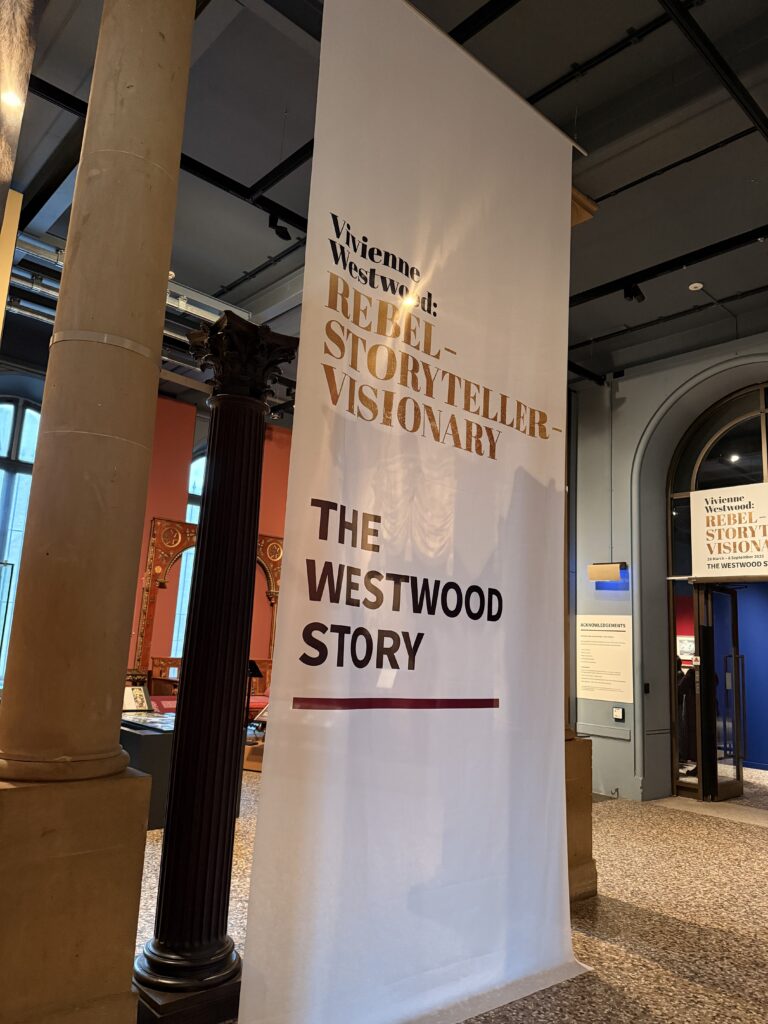
There can be few more fitting homes for an exhibition exploring the work of Vivienne Westwood than The Bowes Museum.
It’s always quite something to walk up the stone steps into this stunning building, one that rises unexpectedly from the County Durham landscape in all its French-inspired grandeur; it feels suitably theatrical before you even step through the doors
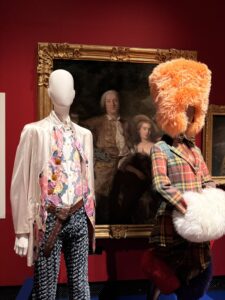
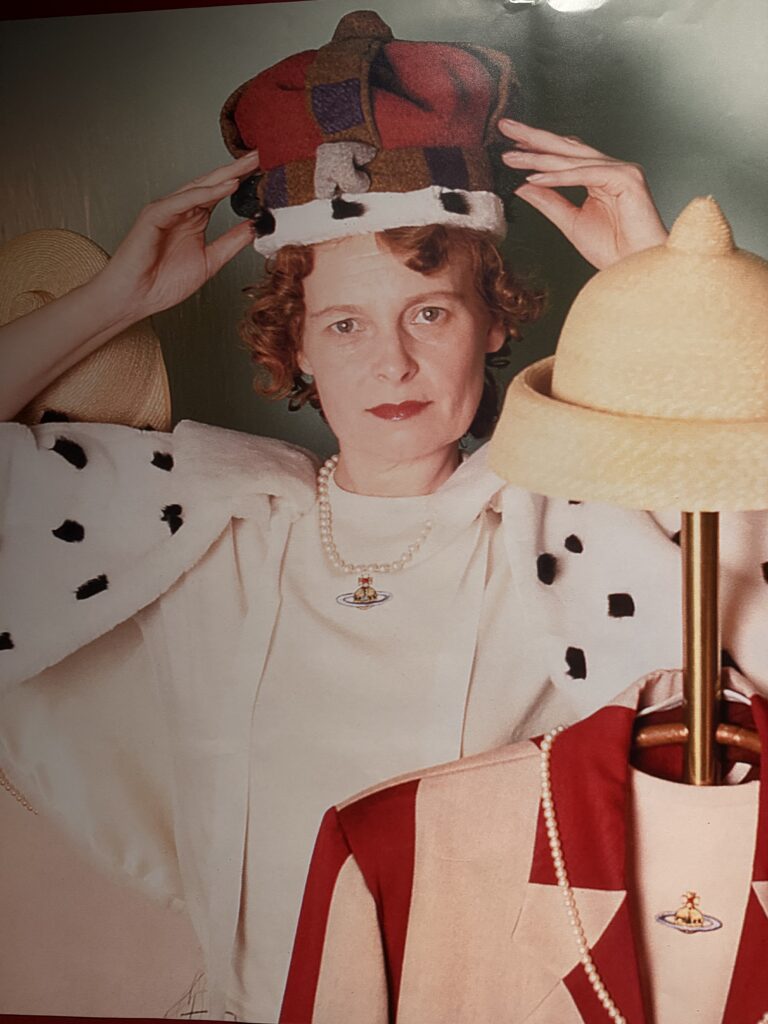
Filled with decorative art, historical clothing, ornate furniture and centuries of collected stories, it seems absolutely fitting that Vivienne Westwood, whose designs continually raided, questioned, dismantled and reassembled the past through a new lens, belongs here. This day there seemed to be a particular spark of anticipation inside the building, the welcoming team clearly excited about the soft launch of this superb exhibition, and a gentle buzzing undercurrent of whispered conversation and expectation.
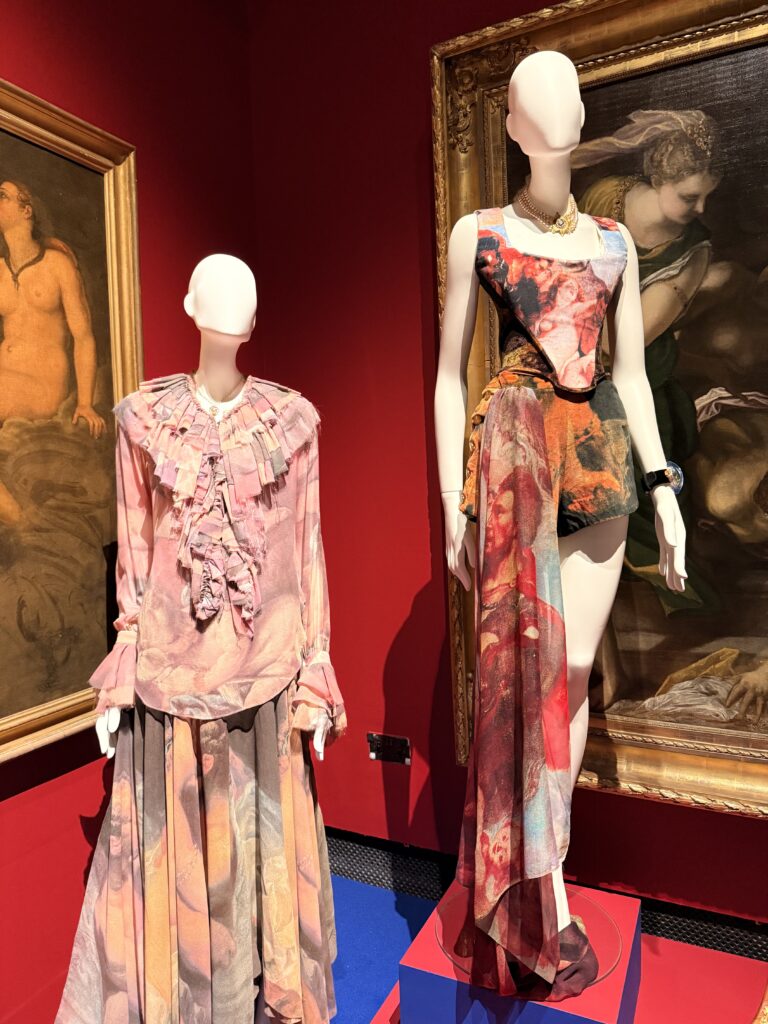
Much to our delight, it was clear as we were guided through, ‘Vivienne Westwood: Rebel – Storyteller – Visionary’ is not simply an exhibition of spectacular clothes placed inside a spectacular building, it is a carefully considered connection between Vivienne Westwood’s work, the historic objects that inspired her creations and the museum collections surrounding it. The result is The Bowes Museum‘s most ambitious Vivienne Westwood exhibition to date, bringing together complete ensembles, garments from rarely seen private collections, historic pieces and an illuminating exploration of how her clothes were actually constructed.
Created in collaboration with private collector and associate curator Peter Smithson, alongside other collectors and partner institutions, the exhibition offers both a chronological journey through Vivienne Westwood’s creative life and a deeper examination of the ideas running beneath the fabric. Peter has collected Westwood since he was a teenager, wearing items as he spoke to us, possibly not surprisingly but most welcome. In The Bowes Museum he said he had found a setting that was capable of presenting the collection with the atmosphere of a historic assemblage, whilst also revealing aspects of Vivienne Westwood’s work that may be less familiar to those who know her primarily through punk, tartan and political protest. Those elements are certainly here, but so are mythology, portraiture, pastoral art, historic tailoring, theatrical performance and an excellent glimpse of the wicked sense of humour that Vivienne had.
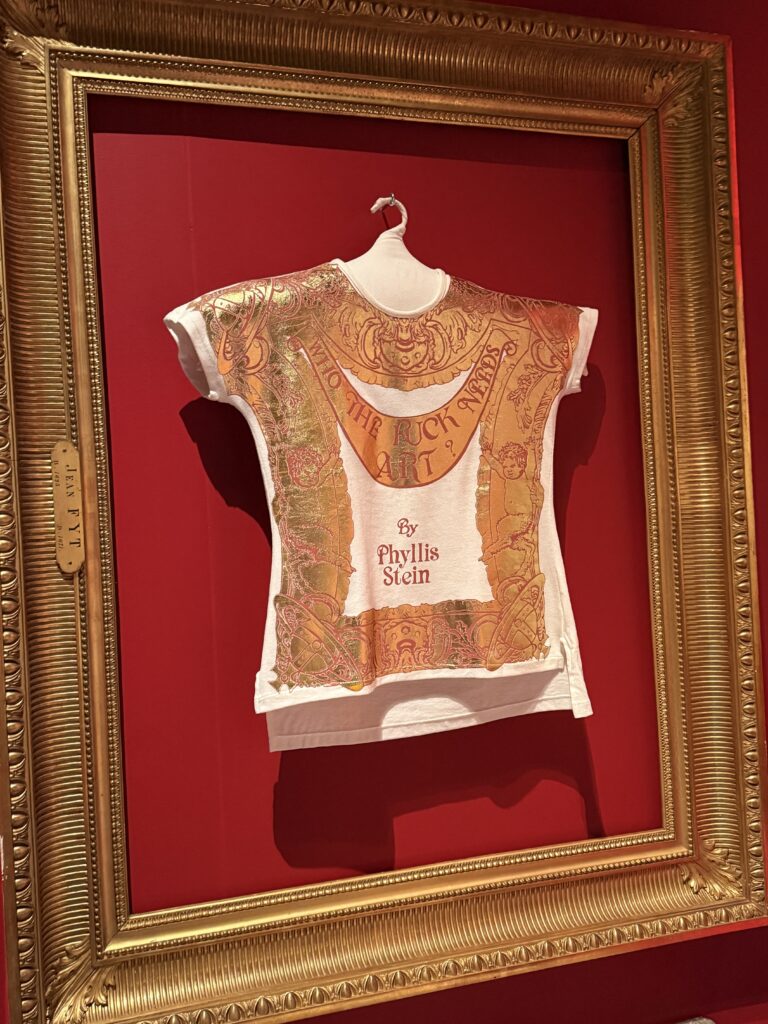
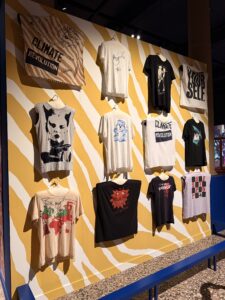
The exhibition wastes little time in reminding us that Vivienne never regarded fashion as merely decorative. Visitors are greeted by a wall of protest T-shirts, bold in both their graphics and their intent. It is a playful and immediate opening, but also a declaration of purpose. Vivienne used clothing to communicate; what we put on our bodies could become a placard, a challenge or an invitation to think differently. This first exposure to the exhibition played directly to my own rebellious, mischievous self, and as I admired the display I reflected, not for the first time since I’ve known of her, how forward thinking Vivienne was, given that much of the sentiment and portrayal was as relevant today as it was when she created them; testament to not only a brilliant designer, a true revolutionary but also someone who deep down saw the visceral flaws with the world.
Her activism became particularly prominent during the later decades of her career, but the instinct to disrupt was always present, her rebellion not being based on rejecting history, but more often, by understanding history extraordinarily well and then refusing to treat it with excessive reverence that at times it seems to expect.
The exhibition gradually reveals the clear contradiction that Vivienne may have been one of fashion’s greatest provocateurs, but she was also an attentive student of art, craft and clothing. From the opening protest wall, the displays lead visitors through a timeline of her work, positioned alongside historic pieces from The Bowes Museum’s own collection. Garments, photographs and moving catwalk footage allowing the source material and Vivienne’s reinterpretations to sit side by side. As the curator guided us through, she was careful to explain not only what was chosen, but why the pieces belong together. Rather than quietly borrowing from the past, Vivienne Westwood seemed to pull it through time by its corset laces, shake it awake and then send it back onto the catwalk.
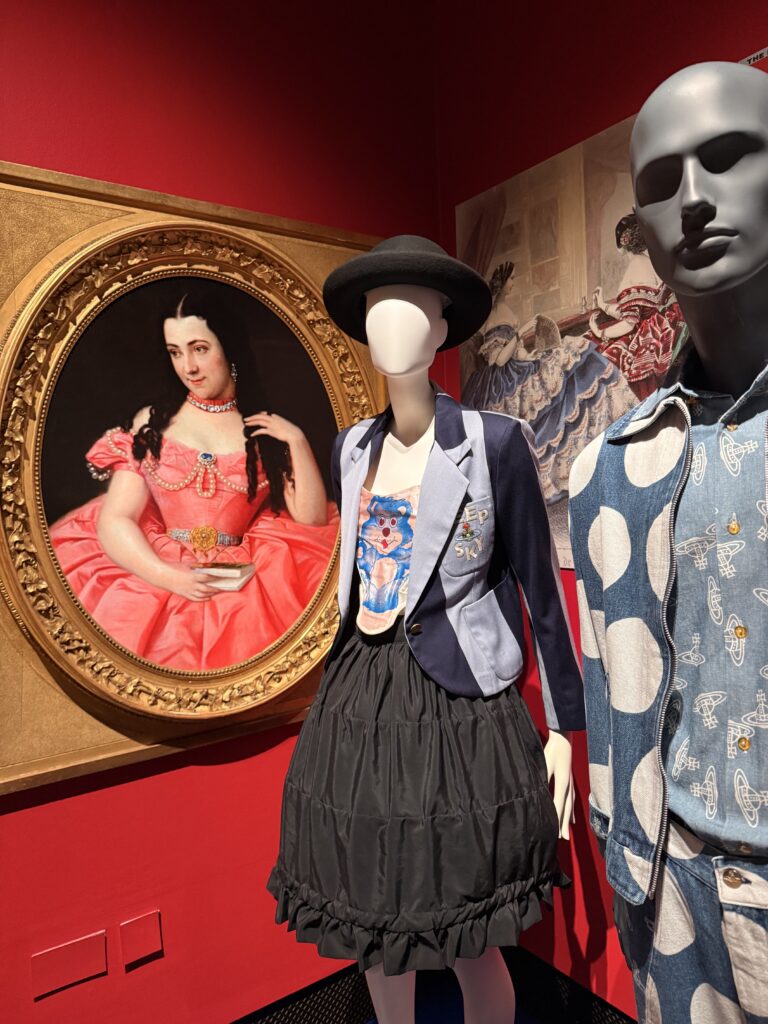
One of the exhibition’s great pleasures was discovering the historic references hiding within some of Vivienne’s most recognisable silhouettes. The Mini-Crini, for example, revisited the crinoline trend, reducing and reshaping a garment that women such as Joséphine Bowes would have once worn, but in Vivienne Westwood’s hands, the grand architecture of this historic dress became shorter, sharper and more playful. And this encapsulates something fundamental about her creative process; she did not reproduce the past, she debated with it and showed it an alternative view.
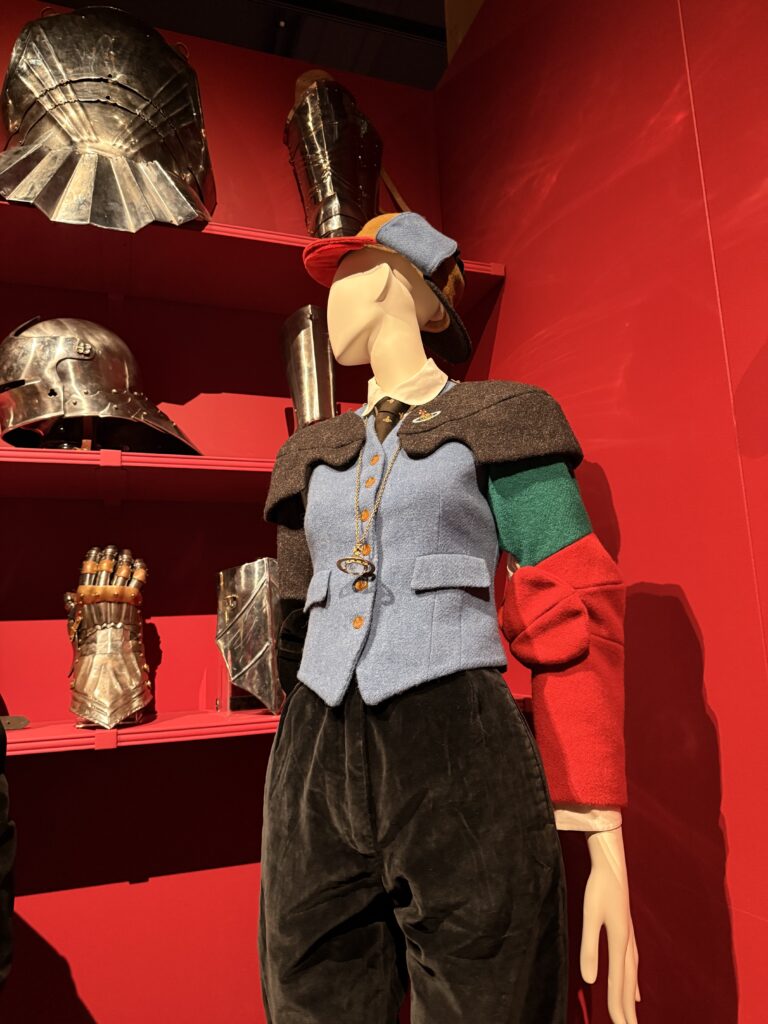
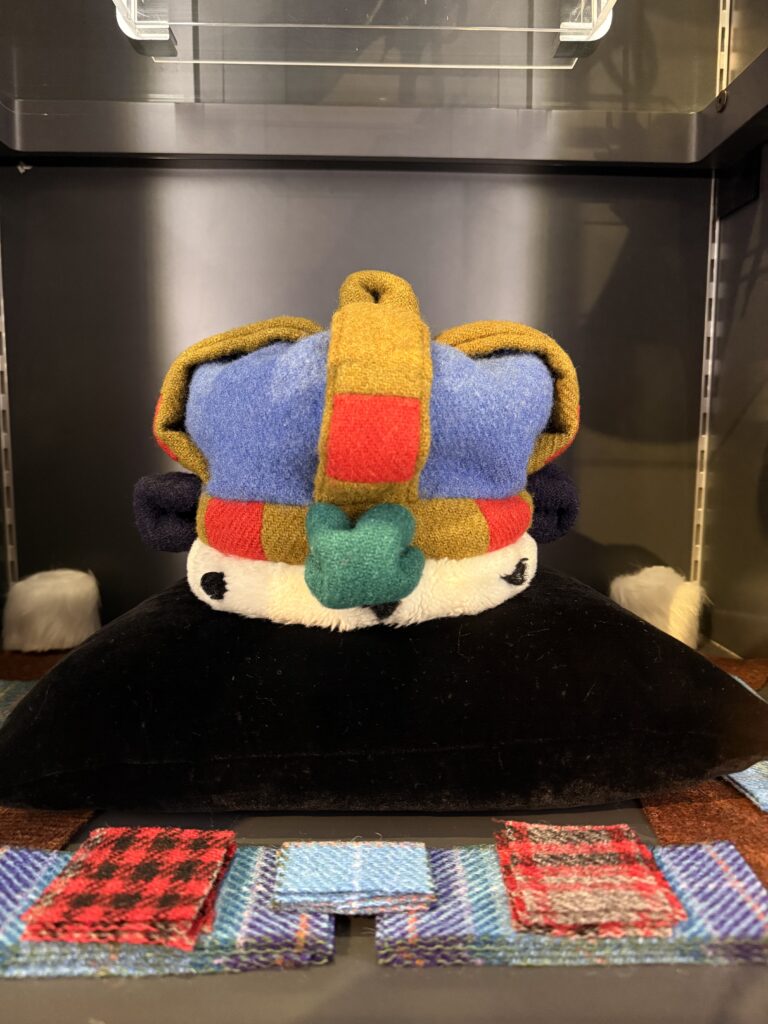
The celebrated Harris Tweed designs similarly brought together traditional cloth, royal imagery and irreverent detailing. One suit incorporates recycled Levi’s denim, an early indication of the environmental concerns Vivienne would articulate ever more loudly throughout her life. Remarkably, as the curator pointed out, the original Harris Tweed collection was created using two domestic sewing machines in her London flat. That in itself is mind-blowing, and there is something wonderfully ‘Westwood’ about that collision of heritage fabric and royal symbolism transformed through determined, small-scale making.
Film and photography bring the clothes further to life. Fashion is designed for movement, and the inclusion of catwalk footage prevents the garments from becoming pure silent museum objects. Among the memorable moments is Naomi Campbell’s famous tumble in a pair of vertiginous Vivienne Westwood platforms, an incident that has long since become part of fashion folklore. There were a number of us in the room who remembered that hitting the headlines at the time, and it clearly reignited the horror but also mischievous glee, as well as the relief that Naomi’s recovery was in fact incredibly lighthearted. For those who remember, it definitely brought more of a light and fun element to the catwalk that many of us unassociated with the industry would never have known about. The footage restores the performance, swagger and occasional chaos surrounding the clothes, and acts as a reminder that these garments did not exist only to be studied, they were made specifically to stride, sweep, wobble and command attention and drama, albeit wrapped up in a ‘creative outlet’.
Vivienne Westwood’s work could carry political anger, but it was rarely devoid of wit. A pair of fig-leaf tights captures this beautifully, the curator telling us that Vivienne fell into fits of giggles after trying them on and looking at herself in the mirror. (It was the t-shirt ‘by Phyllis Stein’ that did it for me.) It is an endearing detail, and a delightful image, revealing the person behind the public image; mischievous, curious and delighted by clothing’s capacity to transform the body. The nearby Harlequin suit draws on patterns and colour combinations popular in the 18th century, with ceramics and decorative objects placed alongside it to make the connection visible, allowing visitors to see how imagery might migrate from porcelain and painting onto a living, moving form. Throughout the exhibition, frames, furniture, ceramics and artworks act almost as visual footnotes, demonstrating Vivienne’s ability to draw upon richly decorative traditions while producing something unmistakably her own.
And this is where The Bowes Museum becomes more than just a venue. Its collection helps to reveal Vivienne Westwood’s creative vocabulary. The Pagan collections unite classical and English references, while the extraordinary armour jacket turns something rigid and defensive into a flexible, wearable form. Here, her lack of formal fashion training appears less like a disadvantage and more like creative liberation, not having to be constrained by an established idea of how a pattern ought to work. That refusal to accept limitations sometimes unsettled critics, not that that ever seemed to bother Vivienne too much given her sometimes quite blunt responses, but also gave her the freedom to create clothes that seemed to operate according to their own laws of gravity and anatomy.
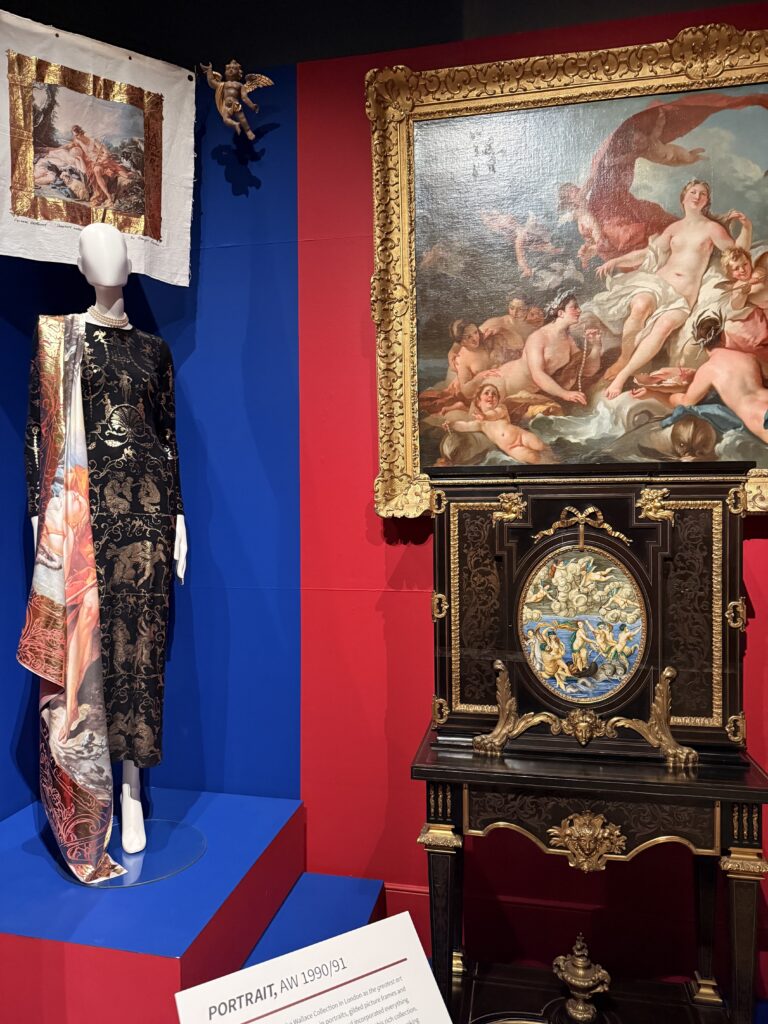
Moving into the 1990s, the Portrait section becomes richer, darker and more opulent. Its gilded interiors evoke the atmosphere of The Wallace Collection, while also creating a connection with John and Joséphine Bowes and their shared relationship with French decorative art. A black dress covered in a gold Boulle-style print appears almost to have absorbed the furniture and interiors around it; not merely a reference to decorative art, it turns the wearer into part of it. I particularly loved the ‘Cut Slash and Pull’ pieces, taking inspiration from the Renaissance where the trend was to slash outerwear to reveal materials beneath, perhaps a nod to punk here as well, and the circle dress and tartan with the most stunning silhouettes, the cut of the fabric doing the work as opposed to the body inside it.
Pastoral imagery associated with shepherds and shepherdesses moves between 18th-century portraiture, corsetry and printed accessories, with safety pins appearing not simply as bits of punk hardware, but as jewellery and identifying emblems. The connections are layered, and the neat categories we often use to separate high art, fashion, subculture and historic costume begin to merge.
The influence of Andreas Kronthaler, Vivienne’s collaborator and eventual husband, becomes increasingly visible from the early 1990s, their creative and emotional partnership reflected throughout later work, including the Anglomania tartan named in his honour. Vivienne’s collaborations didn’t stop there but ventured into jewellery and accessories, with every element contributing to character, whether through a sculptural necklace, an exaggerated shoe or the startling flash of a safety pin placed against the face. The clothing tells stories, but it also creates people capable of inhabiting them.
The second part of the exhibition, presented in the Making Gallery, may be its most revealing. After encountering the visual impact of the finished ensembles, ‘Making Westwood’ strips the process back. Patterns, mock-ups, calico toiles and digitally deconstructed garments expose the thinking beneath the silhouettes. This section examines why Westwood made clothes as she did, not simply what the finished pieces looked like. It draws upon loans and research involving other museums, private collectors and Northumbria University’s fashion department. Historic men’s shirts, for example, became starting points for the shapes of Vivienne’s blouses and smocks, shoes from the 1920s are echoed in later designs, their proportions reinterpreted with her own distinctive flair. Seeing these relationships changes the way you look at the clothes, and, for me, also opened up a whole new appreciation for the meticulous research and inspiration that Vivienne worked with. What may initially appear chaotic was in fact built upon close observation and extensive knowledge; exaggeration supported by construction, rebellion underpinned by research. Vivienne understood the rules before deciding which ones needed to be broken.
The Making Gallery also invites visitors to become participants. Drawing, weaving and dressing-up activities make the space welcoming rather than overly reverential, while the Look Book offers an opportunity to record memories of Vivienne Westwood and reflect upon the effect she had on individual lives. It feels both appropriate and important that an exhibition about someone so resistant to passive conformity should not ask its visitors simply to stand quietly and admire.
Vivienne Westwood is frequently described as the godmother of punk, and the title is understandable. But this exhibition demonstrates how much is lost when her legacy is reduced to one movement or moment. She was a designer who drew from Gainsborough and Greek mythology, corsetry and court dress, Harlequin figures and Harris Tweed. She was a collaborator, activist, researcher, storyteller and technically daring maker. She could be deeply serious about politics and the environment, then dissolve into laughter over a pair of fig-leaf tights; her work treated the past as living material. Historic dress was not locked away behind glass, it could be shortened, slashed, printed, padded, recycled, distorted and given another life. The same gesture might contain affection, criticism, comedy or a mix of it all.
And that is what makes ‘Rebel – Storyteller – Visionary’ such a satisfying exhibition. It avoids separating the rebel from the historian, or the activist from the artist. Instead, it shows how those identities continually fed one another.
The Bowes Museum has approached the exhibition with care, bringing together fashion and fine art without allowing either to become decorative scenery for the other. Each object adds another thread to the story; the building, its founders and its collections all become active participants. Even those without an extensive knowledge of fashion will find ways into the exhibition through art, history, politics, craftsmanship and popular culture. For those who already admire Vivienne Westwood, it offers a closer view of the intelligence, construction and historic research behind the provocation.
Most of all, for me, it presents Vivienne Westwood as someone who kept looking, watching, experimenting and being curious, whether that be related to paintings, people, old garments, political systems or the future of the planet.
As I stepped back out of The Bowes Museum and into the comparatively restrained world beyond its doors, one of Westwood’s most memorable instructions came with me:
“When in doubt, overdress.”
You have been warned.
Vivienne Westwood: Rebel – Storyteller – Visionary runs at The Bowes Museum in Barnard Castle until Sunday 6 September 2026.
April 2026