
There is a moment when walking around The Light in Durham when it becomes apparent that the real achievement here isn’t simply what has been gathered together.
It’s how it has all been brought together.
Artists from the Northeast sit alongside internationally recognised names, contemporary work inhabits a building with a history stretching back to the 1960s, art rubs shoulders with science, technology, military history and deeply personal stories. Even the transition between the original building and its new extension has become part of the experience. Nothing feels as though it has simply been put somewhere because there was a space to fill. And considering the sheer amount there is to see, that’s quite an achievement.
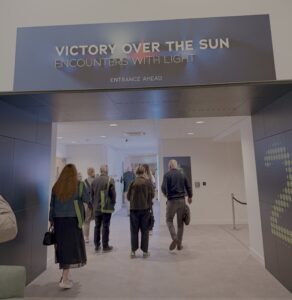
The Light stands on the site of the former Durham Light Infantry Museum and Durham Art Gallery, a building that had been closed for a decade. Now transformed and almost doubled in size, and under the artistic directorship of Tony Guillan, it has been deliberately designed not to erase that history, but to build upon it, which means the building itself becomes part of the story.
Outside, there is another surprise. Despite being within walking distance of Durham city centre and railway station, The Light sits among woodland and extensive grounds, with an outdoor terrace and space for performances and events. You can leave a major contemporary art exhibition and minutes later find yourself surrounded by trees.
Inside, two inaugural exhibitions demonstrate just how broad The Light’s ambitions are.
Victory Over the Sun: Encounters with Light brings together 25 artists from 12 countries, spanning internationally recognised names, emerging artists and artists with regional connections. Guest curator Natasha Howes has been working on the exhibition for almost three years, with its origins firmly rooted in the Northeast.
The spark came when she learned about the process Joseph Swan had employed during his development of the ‘practical incandescent light bulb’. It was an idea that woke Natasha in the early hours, with the beginnings of the exhibition already forming in her head.
From that starting point comes an exhibition exploring light as material, technology, illusion, language, science and something altogether more emotional, and it’s not an exhibition that demands an art history degree before you enter.
There are intellectual ideas running throughout ‘Victory Over the Sun‘, but you can equally walk into a room and simply be knocked sideways by what light can do. Some pieces invite interaction, others change as you move around them. Some are enormous, others deceptively simple, and some carry stories that alter first impressions of the work once you know them.
For example, Félix González-Torres‘ intertwined light bulbs take on an entirely different emotional weight when you learn they were created following the death of his partner Ross Laycock from an AIDS-related illness. The continuing light becomes something tender, a relationship continuing beyond loss.
Elsewhere, Katie Paterson worked with scientists and engineers to recreate the luminosity, colour and temperature of moonlight; a single bulb is accompanied by 289 replacements, their combined lifespan designed to represent the length of a human life. That was one of my favourite pieces in the exhibition; there is something quietly extraordinary about standing in a gallery in Durham and finding yourself, quite literally, bathed in recreated moonlight.
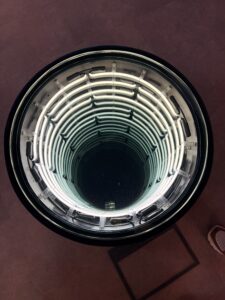
Then the exhibition changes gear again. Rafael Lozano-Hemmer‘s interactive work captures a visitor’s fingerprint and heartbeat, transforming biometric data into part of the artwork while raising rather less comfortable questions about how much information about us is captured and stored elsewhere. Iván Navarro’s ‘Manhole‘, meanwhile, appears to descend endlessly into the floor. Its visual impact comes first; its backstory adds another layer, as Navarro grew up in Pinochet’s Chile, where light itself could be used as a means of control.
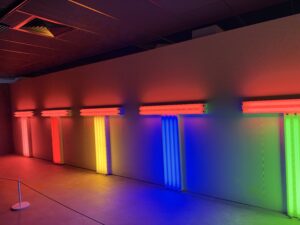
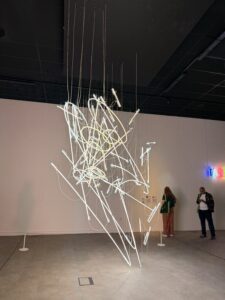
There are works by Tracey Emin, Chila Burman, Dan Flavin, Cerith Wyn Evans and many more.
The relationships between the works matter just as much. Natasha talked about considering how individual artworks would speak to each other across the gallery, and you can see that thinking everywhere; text, technology, science, nature, minimalism and sculptural approaches to light recur and overlap.
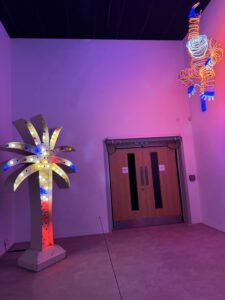
The building has been considered too. Chila Burman’s illuminated monkey hangs overhead, deliberately drawing your eyes upwards and emphasising the height of the new space. Tine Bech‘s interactive work uses a corridor not simply as somewhere to walk through, but somewhere to play. Katrin Hannusch transforms hundreds of broken laptop screens, objects most of us stare at daily, into an intense grid of light and colour, complete with trailing cables that give the work a strangely industrial physicality.
And then there is Liz West’s ‘Our Spectral Vision’. Using dichroic glass, its colours shift as you move around it; not a piece that you simply stand in front of, your movement changes your whole experience of it.
And that, perhaps, sums up much of ‘Victory Over the Sun’; this is an exhibition to move through, around and sometimes into.
Descending to the next floor down, ‘We Are The Durhams’ feels like entering a completely different world, yet the more time I spent there, the more connected the two exhibitions began to feel.
The permanent Durham Light Infantry exhibition could easily have become a chronological procession through campaigns, uniforms, medals and military dates. Instead, its starting point is people.
Curator Gillian Kirkbride and the team have taken a vast collection, more than 15,000 objects alongside hundreds of thousands of archival photographs, diaries and other material, and asked a much more interesting question; who were the people behind the regiment?
The answers immediately dismantle any expectation that the DLI story begins and ends with soldiers in trenches. These were artists, musicians and actors. They played sport and staged ‘Henry V’ while training for conflict, they travelled, wrote diaries, formed friendships and families and somehow maintained humour and creativity in circumstances where you might least expect to find either.
There are some stories that totally stop you in your tracks. Teenager Margaret Arnot joined the ATS attached to the DLI, went on to work for Eisenhower, and danced in the streets of Paris on her 21st birthday as the city was liberated and was in Berlin when it fell. Elsewhere are Enigma machine components and the story of a radio secretly assembled in a prisoner-of-war camp from separate pieces hidden by individual prisoners.
The exhibition does not avoid the brutality of war, but neither does it allow war to swallow the people who experienced it. Gillian describes the DLI as a family and community, and the exhibition has been developed in close collaboration with veterans, DLI Friends and the Association, and their voices, research and personal stories clearly run through it.
It gives ‘We Are The Durhams’ an authenticity that would be difficult to manufacture through objects and interpretation panels alone. There is laughter here; theatre, sport, curiosity, ingenuity. Ordinary lives colliding with extraordinary moments in world history.
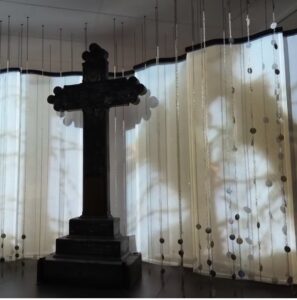
And then there is the cross. A First World War memorial cross from the Somme was made and erected on the battlefield during the battle itself. While it was being raised, the German forces did not fire. Around it now sit individual identification tags representing the men who died in that action, researched and created by DLI Friends. It’s not given any theatrical excess, and it doesn’t need any.
There are other objects and stories towards the end of the exhibition that are equally compelling, including one particularly unusual item donated that manages to be fascinating and distinctly eerie. But I’m not telling you what it is, some discoveries are better left inside the gallery.
On paper, ‘Victory Over the Sun’ and ‘We Are The Durhams’ wouldn’t necessarily belong together. One is an international contemporary art exhibition examining light through art, science and technology. The other explores more than two centuries of regimental history rooted deeply in County Durham. Yet both are ultimately about people. Both take enormous subjects and find individual stories within them, both move between local experience and much larger events, both ask visitors to look again at something they may think they already understand.
Even the process of curation shares behind-the-scenes consideration. Natasha describes choosing artworks partly through the relationships they could form with other works around them, and Gillian talks about choosing DLI stories that can lead into four or five other stories and conversations. That care and attention is visible, as is the ambition behind The Light itself.
Art, history, science, technology, performance and community activity haven’t been kept apart; the whole intention is for them to meet, overlap and start conversations. Perhaps most importantly, though, it doesn’t feel as though County Durham has been given just a regional version of something that would normally happen elsewhere. Internationally significant work has been brought here alongside Northeast artists and stories rooted deeply in local communities, and neither is treated as less important than the other. The old building hasn’t disappeared beneath the new one either, its history remaining visible while the new spaces allow something much more ambitious to happen around it.
I went expecting to review two exhibitions. I came away thinking about the stories behind dozens of individual artworks and objects, about moonlight recreated inside a gallery, a teenager from Durham dancing through liberated Paris, light bulbs representing a lifetime, actors rehearsing Shakespeare while preparing for war, a cross erected whilst the guns temporarily fell silent, plus all the other stories I still hadn’t had time to discover.
And that’s probably the best thing I can say about The Light; one visit doesn’t feel remotely like enough.
August 2026