
In Conversation With: Paul Smith, songwriter and frontman for Maximo Park.
Paul Smith:
“…if you’re honest and you are doing your own thing and you have your own voice, then it’s easier to deal with the ups and the downs because you believe in what you’re doing.”
I was hugely grateful to NE Volume Magazine to have had the opportunity to speak (at length as it turned out) with the ridiculously lovely and charismatic Paul Smith, singer/songwriter and frontman for Maximo Park, ahead of their 20th anniversary celebration tour of ‘A Certain Trigger’, kicking off in February
Here’s how our conversation flowed…
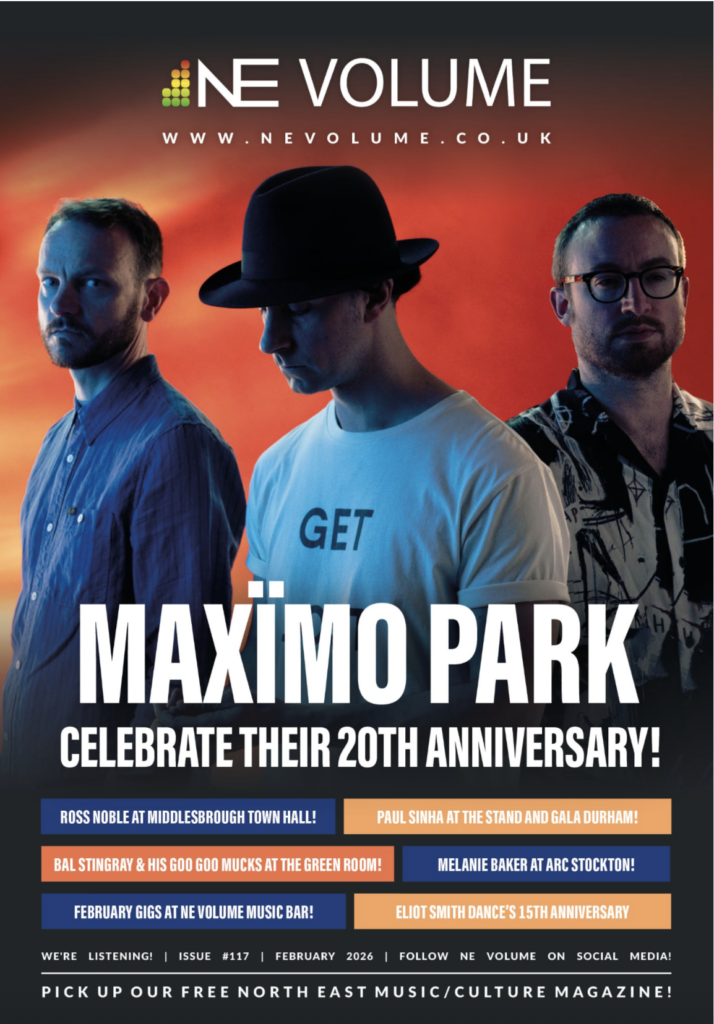
So we’re on the brink of the tour of the 20th anniversary of ‘A Certain Trigger’. How does that milestone of 20 years since your debut album feel from where you’re standing now?
Well, it feels kind of unusual, in a way, because most people don’t live their lives with this kind of landmark moments, you know. I guess people have wedding anniversaries and things like that. But in terms of, I know exactly where I was when it was released, I know the kind of general atmosphere and what it felt like, although that is becoming harder to discern at this distance. You remember things in a certain way, and things may have been slightly different as you get older. I don’t think of it that often. But then the last year or so we’ve been doing a reissue of the first album with loads of demos and getting old photographs for a poster inside the reissue, and then we’ve obviously got the shows coming up. So it’s been a longer period than I would usually have to assess an old record or a certain era. And so you kind of come to terms with the things that you’re less happy with about that time.
Do you find now, when you’re listening to that, you kind of think, oh, goodness, why did we put that track in there? Was there something else that could have gone in place? Or are you still really happy with how it came out?
I am happy with it. I think there are certain moments where you’re like, oh, that’s on the edge of one thing or another, mostly kind of quite angsty stuff. Obviously, I’m literally 20 years older, and you think that was me, and those were the things that we believed in, those are the things that we thought were the right thing to do, and by and large, I’m very proud of this. And even those kinds of things that you laugh about or feel a bit slightly awkward about, which are few and far between, I have to say, those are the thoughts of a young man in his early 20s to mid 20s, who was living in Newcastle, who’d grown up in Billingham and from whatever socioeconomic background. What is on the record doesn’t surprise me in that respect because I’m aware of my roots, where I’ve come from. And I don’t mean just my background, but just the things that I was into at the time, the records that we loved, the records that I hadn’t heard yet, which are probably, if you’d have heard a different set of records, you might have made a different kind of record.
So yeah, it’s very interesting, but I think there’s a real sort of energy to it, which remains a constant in the band, you know. The DNA of the band has the kind of ramifications on what we make now, rather than trying to change completely and obviously not staying stuck in the past either. So we’ve tried to evolve as time’s gone on. So I feel like a lot of the things that are what make ‘A Certain Trigger’ a good record are the things that hopefully make ‘Stream Of Life’, our last record, a good album, and we still have the kind of spark and excitement about music and working with each other and the things that we can possibly come up with as a group, which is a kind of a key element of any group; the kind of collective that you have and the sort of, again, different influences bouncing off each other and different sensibilities. Whether it’s melodic or lyrical, all of those things go into the making of the records. And I think you realise, especially, yeah, to look back, how many of our peers or so-called peers, some of them were, you know, I didn’t think were our peers, but you get lumped in the same box, not many of them are still going. Again, for some people, their lives take a different path, other people get dropped from record companies, other people get proper jobs, and you know, live a different kind of life. So it’s very interesting to look back and think about all of those different things. I have ended up just thinking about life in a more general way, which is, again, not unusual for somebody who’s looking back at any landmark in their life, but, you know, we didn’t know that 20 years later, we’d still be doing it. We didn’t know we’d be in the same band, or anything like that, we just wanted to make a great record that stood the test of time. And we feel lucky that it has stood the test of time, but also that was our intention. You know, we didn’t want to be flash in the pans. We developed on our own, living in Newcastle up here, away from any particular scene. And yeah, all of those things swim around my head when I think about the 20 years.
It’s such a raw interpretation of a young man’s attitudes and what’s happening in the world around him and everything else, which is what makes great music. It’s what locks onto your audience, doesn’t it? It’s a fabulous album that obviously stands the test of time. Like you say, 20 years later and you’re still celebrating it, which is amazing. So, when you made the record, when you first created the tracks, did you have an impression you wanted to make on the world, or was it just random thoughts and attitudes, angst, and various stages of where each of the band were in their lives that kind of came together as a collective?
Well, I wasn’t really a singer, and so for me, it was like “all right, well, I think I can write lyrics. I’m not sure if I can sing, but I’ll write some lyrics, and I’ll turn up to the first practice and see what comes out of my mouth”. And, you know, it was nerve-wracking, but you have to kind of conceptualise it from my point of view anyway, from somebody who thinks about music in that way, it needs to be a bit of everything. It needs to be exciting and visceral and something that is impulsive and immediate, but also I want to reflect on it as well. I want it to be, you know, as well as being immediate and kind of poppy and, I suppose, that sort of simplistic aspect of pop music. The music that I like does have that kind of introspection, and it does have all of the cerebral elements to it, and that to me is a lot of my favourite music. So that was the kind of music that I wanted to make. And the rest of the band had already been making music together for a couple of years, and they were really tight and had some great songs, and I felt like, okay, there’s a lot of material here for me to work with as somebody who doesn’t really know what they’re doing. So that was the kind of safety net for me, really, that they were a great band already, and I was just trying to find a way of fitting into that whilst retaining my own identity within the band. And I think the stuff that we were aiming for, I was thinking about it in terms of, I guess, art rock, like the kind of Roxy Music, The Smiths, because obviously we were a band. You know, you get to think about where you are in the lineage of bands, having great album sleeves, having great lyrics, everything should matter in the band. You know, the drumbeat should be as important, and the rhythm should be as important as the lyrics, blah, blah, blah. To me, it felt like that was the kind of aim. And in terms of the subject matter, again, it was more like, well, honesty is the best policy a lot of the time in music. I don’t have a great imagination, I have to say. I kind of use my own life and the things that I can see with my own 2 eyes, whether it’s in a book or something that’s going past on a train, experiences that you’ve had, relationships that you’ve had with different people. All of that can feed into the music because living your life is a multifarious, multi-dimensional experience, and that’s what I wanted to try and convey within the lyrics. I’d like to think that there’s a bit of everything in there for people, you know, there’s some very specific things, but also a universal aspect which comes out of the honesty, rather than aiming to do something that’s universal and that everybody’s going to like, which will often end in very bland music. It was kind of tapping into as many things that were from real life and specific, and trying to find the universal elements in them and chip away at the songs and chisel them until they’re this thing that you’re happy with that balances the 2 elements. And it’s the same with the music, we wanted to try and have something that was interesting to listen to, but also, yes, it has loads of hooks; and, you know, with Maximo Park we try and cram in as many hooks as we can. Sometimes that’s, again, like a high hat that follows the vocal on ‘Apply Some Pressure’ or whatever, there’s bits where Tom’s following my vocal, and I was like, this is great, the drummer’s listened to me. And that’s it, we should all be listening to each other and trying to come up with this unified force through the different elements of the band. And I feel like when it was time to present this, that sort of energy of life is in there. Yes, there’s a bit of angst, but there’s also kind of humour as well. Songs like ‘The Night I Lost My Head’ or even ‘Apply Some Pressure’, “What’s my view? Well, how am I supposed to know?”, it’s a kind of running commentary on the absurdity of life and sometimes that absurdity ends up with romantic calamity, other times there’s a lot of escapism on the record because I was growing up in a small town and moved to a bigger city, still in the northeast, but that shift is definitely displayed in songs like, ‘I Want You To Stay’ where it talks about “I long for the neon signs of night because nothing works around here” and “nothing happens in my town” in ‘Graffiti’. And believing in romanticism. I think that was the worldview that I wanted to put across; romanticism with all of its pain and beauty. There’s a lot in that, I guess.
And again, everything that people can relate to, or most people, I would imagine, can relate to both sides of that, can’t they? So, you know, that’s why it hits so well. So when you came up with a reissue, obviously, there’s some kind of surprises, some rarities. I love the whole Janice Long thing, the fact that there’s that snip at the end of her talking was lovely. How did you decide what to dust off for that? What actually made the mark for the reissue?
Well, from my point of view, I wanted it to just be interesting to the superfan and the casual listener, really. There’s plenty of demos of certain songs, and yeah, you could just dump it all on there, and there’s some minute differences between things, but to me it was if something sounded kind of different to the final version, let’s put that on there, something that captures a spirit that is different, again, different to the final version. I mean every album should be a kind of document of its time, in my opinion; what you’re into, whatever thematically, what musically. And I think even with this reissue, I was thinking, what displays who we were at the time, even just the sound of us playing. So there’s a couple of demos from this session that we did in Gravity Shack, which was a studio in London, run by Pat Collier, and a guy paid for it who was interested in publishing our songs and I think somebody had given us some money to just go and get some demos down and then he could play it to other people or to record companies or whatever. And you can hear how close we were to the final thing without even meeting Paul Epworth, even though Paul Epworth did an incredible job and really, I think, you know, enhanced our sound further and helped us with the arrangements on certain songs like ‘I Want You To Stay’. He said, “Oh, I’m not sure about this bit. Why don’t you just finish writing that section? It doesn’t sound quite right.” And, you know, you can hear the original versions and kind of compare and contrast. But yeah, there are all sorts of different reasons for things being on there, and obviously, all the B-sides we felt should go on there for better or for worse. And, you know, some of them were done very quickly, and those are the things that I look back at with a little bit of a kind of, did we really do that? But it’s, again, you’re just like, all right, well, it’s a product of the time, and it’s those songs that you were like, oh, yeah, I’m not sure about this one, let’s just give it a go. Whereas everything on the record felt like it belonged on the record, and that obviously leads to a record that you’re happy with years later. That’s the general idea, but it doesn’t always work like that. You know, you end up with certain songs on certain records, you think, “yeah, maybe we should have put this one on, or maybe we should have done it that way.” And I think the B-sides give it a sort of an insight into the raw, a sort of process of being in a band, certainly a new band and a young band and some fairly silly things on there, like little musical ideas, certain lyrics. I’ve been listening to them today because we’ve been rehearsing and we’re gonna throw in a couple of rarities and old B-sides, you know, the ones that we still like.
Clearly you’re not going to play ones you don’t like, are you?
No, no, but this is it. We were pretty prolific at the time. Most of us had proper part-time jobs when the record was being written, so we did have time to reflect on things and work on demos at home, and Duncan recording everything was really handy. So we did a lot of home recording with him at the wheel. And I say, I was listening to it this morning, and I went past the ones that we were rehearsing and just let it run. And yeah, it’s just a strange mix of pride and embarrassment, but mostly pride in the end, I’m glad to say.
That’s good. Were there any tracks that maybe even back in 2005 perhaps felt a bit odd, and maybe didn’t make the grade then, but now seem to make so much more sense and are maybe relevant for now as opposed to 20 years ago?
Well, it’s funny because there’s no universal agreement within the band.
Really? Oh…
So there’s a song, again, that I was listening to today, which was a B-side of ‘I Want You To Stay’, and it was called ‘La Quinta’, which is named after a hotel that we were staying at in America on one of the early tours. And ‘I Want You To Stay’ was the last single off the record, and so we just had certain experiences of being away, and then we were back home, so we had a bit more to think about in terms of the lyrical themes and whatever for some of the later B-sides. Whereas some of the earlier ones were written well before ‘A Certain Trigger’ came out, and they’re interesting in their own way. But anyway, we were talking about what to include, and Tom, our drummer, was not 100% on ‘La Quinta’, whereas I really loved it, and I was like, “No, no, it’s definitely got to go on.” I think, you know, he sees the good in it, but it’s not his favourite one, whereas I was listening to it, and it’s got kind of a sort of spoken word intro, and then these kind of interesting harmonies on it, which remind me of Squeeze, who I loved when I was growing up, and this kind of low vocal with the high vocal, and and it has a kind of Brian Eno aspect to it, which you wouldn’t normally associate with Maximo Park, even though we’re all big fans of Brian Eno, it’s not where our music is necessarily coming from. And so yeah, to me, that could go on a record, an interesting sort of a different kind of art rock, a sort of more Eno art rock, instead of the sort of, I guess, the punkier, a more aggressive art rock that we did. So, yeah, that’s one that I was listening to today and feeling proud of it.
Also, there are 3 of you to vote. So, someone’s got to have the casting vote, right? So…
Exactly.
Well, that’s really interesting because you’ve been quoted in some BBC comms as well, saying that not many bands make it to 20 years, certainly not in the same form, necessarily. So when you first set out, I know you joined the band a few years later on, but did you always have this kind of like iteration type attitude to the band and the music that you make, or was it something that just evolved?
Well, I think it’s definitely evolved. I feel like the kind of rawness and amateur aspect of it, you know, I never really wanted to be a rock star or anything like that, and it was embarrassing to me to think of rock stardom. Too many people who are in bands, you know, they’re clearly in it for the rock stardom and haven’t thought as much about the music as they possibly should have done. Luckily, we all chipped in, and Lukas would co-write songs with me and Archis would, and we’d all sort of chip in, bits and bobs here and there. But I guess the core songwriting partnership is me and Duncan; for whatever reason, there’s a click between the way that I write and the way that he writes and the lyrics that come up that go with the melodies that he’s got in the music. Luckily, everybody was happy for me to write about the things that I wanted to write about or to put a spin on things that were already in existence, like the song ‘Graffiti’, and add my own lyrics to try and make sense of it for me, because I was coming in and needed to express myself and have kind of part ownership of the songs in order to feel like I was fitting into things. But, you know, as you get older, you realise more and more, and the idea is to get wiser as you get older, and I still feel like I don’t know anything, but I know that I know more than that guy who made ‘A Certain Trigger’. And that’s the strange thing about getting older, you have certain aspects of wisdom, whether you choose to apply them to certain situations or not, which is another human trait that we do make the same mistakes over and over again, which can lead to some interesting songs, but a lot of frustration. But yeah, I wish that I had enjoyed it a bit more. As I get older, I know that I can make music and it’s my income, and I have the freedom to read a book, and hopefully it’ll influence my writing in some way. I was influenced more, more by singer-songwriters, and the idea that when Maximo Park asked me to sing, eventually, as we were kind of coming up with songs, I did think, well, things that I seem to write are more kind of singer-songwriter, and, you know, very, I suppose, introverted, and it’s interesting to have that next to the kind of music that we’re making because it doesn’t feel downbeat and it doesn’t feel singer-songwriter. I feel like, again, looking back at the sort of popular bands of the time, our music is much more emotionally driven than other bands that were around, you know, there’s a kind of irony or whatever. I don’t mean this in a critical way, it just feels like we were very much apart because we were willing to wear our hearts on our sleeves through me as the front person and to try and look different, to be different, to sound different, just to make a point, almost, that we were different. And I think sometimes you think, oh, you could have been a bit more relaxed about that. And you are what you are, and you don’t need to try so hard to be different, but that was part of the deal. And again, you can’t have hindsight as you’re living through the moment. You have to choose to do whatever you do and try to make the right decisions. But yeah, I think that sort of believing in the magic of the everyday, I feel like after going to art college and meeting different people and studying different artists from different disciplines, and then I did a Master’s at university where I was kind of going through the birth of popular music and how that had developed and I thought about music in a kind of conceptual way just because I wasn’t making it necessarily. I was playing guitar in my instrumental band, which was more influenced by American post-rock; no vocals, just a very different kind of way of making music, but at the same time, applying the same methods to being in Maximo Park, you know, assembling things together and seeing what comes out of it. So I think you always try and evolve, and I’ve always tried to step outside of it, even though I’m very involved. Like, I can’t step away from a lot of the songs that we’ve written because they’re about things that I’ve experienced, and I feel affectionate towards them or involved in them in a very different way to somebody else in the band who might go, ah, you know, that song didn’t quite work. I’m like, it may not have worked, but I still love it, and I’m still involved with it, and I just can’t see the kind of wood for the trees. But then I’m also always trying to sort of step back and go, how, what does this look like in the bigger scheme? You know, are we providing people with something different to other bands, to other artists, and are we providing something different with each record? Otherwise, there’s no point. You know, we’re not here just to churn out stuff, it’s completely pointless to me. I mean, there’s a point to it, of course, to try and make money to earn money to live, and I understand that as well, but it’s the difference.
The difference of going into the industry, wanting to make money or just turning out whatever the audience wants, versus what you actually want to follow creatively as a band?
We were always a pop group, and that was the thing. It wasn’t necessarily fashionable to say that.
I would never put you as a pop group personally.
No, well, this is it. I mean, I think, people hear the guitars and the keyboards blasting, and we are, in many ways, we’re alternative, we’re alternative rock. But ultimately, it comes down to the song for us, and whether it’s because of our ‘hooky’ nature, it is sort of our own melodic sensibility. I like George Michael as much as I like Public Enemy, you know. I like the Kinks as much as John Cage. To me, it’s just sound, and I do like a lot of melodic stuff, but also, in the end, you can only make the records or the music that all 5 of you, in our original incarnation, this amalgamation of interests and influences. Too far in one direction and somebody’s not going to be into it. So, you know, it’s a beautiful compromise in the end. And to me, it was always “this song has a chorus”, “this song has a middle, it’s very catchy.” It’s about something that other people can relate to. Therefore, it’s a pop song, but how do we mess with that? How do we disrupt that signal? And to me, because we’ve always made, in my mind, pop songs, whatever, however they appear and materialise and are sonically shaped, they come down to that core. And therefore, for it to be popular is not a massive surprise in the end, even though it kind of is, to think that anybody can be successful. It was intentional. It was to say, “right, this is pop”. You know, pop takes many forms. This is one form of it. Pop is music that transcends its genre and is just popular. You can kind of make of it what you will, in a way, and then you can, you can use it as an excuse for all sorts of things.
Can we go back to your frontman statement saying that you never wanted to be the frontman, because you are credited with being an excellent front person of a band? You’re very charismatic, you’re always full of energy. Where does that energy come from? And do you thrive off the audience, from the band, or is it just inherent in you and you’ve just discovered, actually, you are a frontman, even if you thought perhaps it wasn’t the place you were going to have in life?
Yeah, I mean, it was obviously in there somewhere. And I think, friends that I’ve grown up with, they know that side of me, but they’re also kind of alarmed as well because it’s not something that you would normally do. And it just goes to show what a strange situation being on a stage, trying to get people’s attention whilst singing is, it’s an unusual activity. If you think about it. And this is why I kind of play up to the sort of artifice of it and kind of dress up. It’s like, I am on a stage, there’s no denying it, and it’s weird, so let’s just go with it. Also the kind of friction that that has with these very personal songs and trying to bring them to life for a big audience or even for a small audience, you know, like, even when I play solo, you know, there might be a 100 people there, however many people there are, you’re trying to command a room and trying to get them to like what you’re doing because you think it’s good. And that goes back to the question, really, I only perform the way that I do because I believe in the music. And if I didn’t believe in the music to this extreme degree, then it would be difficult for me to do what I do. And that’s always driven me. Before we started, before we got signed, I drank some wine with a friend before going on, and I was extremely exuberant and thought it was a great show. We were in London, and somebody recorded the show on the desk; it was just kind of industry people there and people who just wandered into this place. But I was out of tune, and I pride myself on, if nothing else, even if you don’t like, if my voice is not to your taste, at least I’ll be in tune. And so since that day, I’ve never drank before going on stage or anything like that. And people used to come up and go, oh, you were crazy out there today, and I’m like, but it’s the music. And it’s not just our music, you know, I love music. This is the thing I’m obsessed with music, and I have observed probably lots of different things over the years that have fed into my performance, and you get more and more confidence the more that people come and see you, not just in performing, but in singing and what you can do with your voice. And I feel like I’m a much better singer now than I ever was, because I’ve practised. I haven’t had singing lessons, but I’ve actually sung the songs over and over again and sort of become more comfortable and connected to the way that I sing in to my voice. So, you know, all of those things allow you to do something a bit different on stage. And the energy of the songs, we’ve always made very upbeat music, and there’s a crackle of energy on the records, and then when people come and see us, they get that sort of in a kind of 3D sort of enhanced way. And as you said, once, if the crowd are digging it, then I’m going to get a lot from that. I don’t know how many times I’ve sung ‘Apply Some Pressure’ now in my life, but it’s a lot. And even including practises, especially where you’re like, oh, I’ve got to sing this song again, and I kind of know it inside out. And then you come to place at a concert, and it’s new every time because the audience is living. It’s living, they’re living the moment, and I’m in the moment. Some nights I’m conscious of, ‘oh, did I do that with my hand last night?’, or ‘did I jump up at this time in the song?’ And sometimes, I’m like, right, I won’t do that again, tomorrow night I won’t be doing that. But then other times I’m like, that’s okay, you know, because I’m believing it. I feel if it was too rehearsed and it’s the same when I speak in between the songs, I am making it up as I go along, and I want to respond to what’s happening right there and then, I don’t want to go through the motions ever. And 20 years down the line, I still believe in that, that’s my modus operandi; to try and live in the moment, to try not to repeat. I feel like, for whatever reason, I have the capability to do it and believe in what I’m doing. And I think one of the worst things somebody said about our band was, there was a review, and it said, “Oh yeah, Paul Smith’s phoning it in,” and that’s the thing that probably made me most angry over the years because I’ve never done that. I don’t know, they either weren’t watching or had preconceptions about us after us having some sort of commercial success and have obviously played many, many shows, and, you know, have the confidence to perform over and over again. I still believe that you have to tap into what’s happening. And for me, I think about what the songs mean to me now. Sometimes you’ll get a kind of flashback to what the songs were originally about, and so my mind’s kind of racing while I’m on stage. And I guess, what I was saying earlier on about trying to enjoy it, the earlier shows, the more I was trying to prove myself to people, and you feel the pressure to make a name for yourself and for people to understand how much you care about it, which, again, I don’t feel like that’s there now, I don’t need to do that. But then at the same time, you know, by me, by me performing, you can kind of see how much I care, and when I speak to people about the band, you know, I just feel enthused by what we’re doing. I feel like it’s a live thing, it’s a relevant thing. Which makes it easier to do the 20th anniversary shows because it’ll be like we put out our last album and it’s been 20 years, so you’re like, “all right, let’s celebrate”. Let’s play our songs and revisit a lot of the first record and try to just pay tribute to the songs, you know, and again. That’s my intention, let’s see what happens.
Absolutely right. So, were there any influences on your frontman persona? Did you take any notes from anyone in particular? Did you have a muse, maybe another frontman or a couple of other people who you thought, actually, yeah, I want to kind of emulate them a little bit.
I mean, you end up thinking what shall I do on stage? I usually play just guitar, and I’ve got films behind me, and I do a little kick to get to the next bit of the section of the song because it’s instrumental, and we don’t really know what we’re doing. And I sort of took that into “I’m going to dress up”. To me, it was like a strange amalgamation of Bryan Ferry and this kind of romantic sort of, very English silent movie star, but then also Iggy Pop and somebody who’s kind of out of control, for other people’s entertainment. And then somebody like David Byrne, as well, from Talking Heads, because, again, he was an oddball and he was not afraid to be unusual. I think the thing that I sort of took from that was not just the sort of presentation and the kind of attention to detail, but also the idea of being awkward, you know; I don’t feel entirely comfortable. I feel much more comfortable now, but when we first started, I was like, “Right, I’m going to exaggerate my movements, you know, I’m going to try and if I’m feeling something, I will exaggerate that.” A lot of the time it was awkward or somebody shouts something out and they don’t really know, you know, but this was before we obviously had a very strong fan base. And I mean, it’s funny because, you know, once the first album had kind of taken off a little bit and we were getting played on the radio and on Top of the Pops and stuff on the telly, we had quite a big fan base by the end of that year, 2005, and so it became easier to kind of celebrate because, even like songs like ‘Going Missing’, which are kind of painful in some ways, about negative emotions, it was, when you get to the chorus, it’s kind of anthemic, and watching thousands of people singing it back to you, you can’t help but get caught up in that. And so there’s kind of a strange mixture of this kind of joy and also trying to tap into what the songs are about, which, again, makes for an interesting, you know, an interesting presentation. I feel like just before we started playing in front of lots of people, we went to, it must have been 2014 ‘In the Park’, and we were just about to make the album, we’d signed our deal with Warp Records, and we were watching PJ Harvey, and I was, again, mesmerised. I was a big PJ Harvey fan, so I was excited, but to see somebody drawing you in in that way and using her body to draw you in and moving, moving around in her facial expressions and, seemingly, enjoying the active performance. As somebody who’s kind of obsessed with music, I was probably taking from all sorts of different places, but I guess those 4 are sort of the ones that stick out around that time.
That makes complete sense now that you’ve said it to be fair. So if, for example, I mean, you’ve just said you’re so into music, I can’t believe you wouldn’t be in the music industry one way or the other, but you know, a sliding doors moment… if you hadn’t joined the band, where do you think you’d be?
Well, I was teaching it at Stockton Riverside College. teaching arts, drawing and painting to people, so I think I probably would have gone down some sort of art education path, even though I wasn’t qualified to do that, which is another story. I’d washed up there after finishing my MA, and I’d worked in a call centre for 6 months, and it was a kind of real negative experience, really, after coming out of not having a proper job. And that’s what sent me into Maximo Park, really. I agreed to come and sing and be slightly embarrassed in front of these people because Tom, who was in my art history class, and who I knew had wanted me to be in the band, asked. And because I was working in a call centre, I wasn’t enjoying life necessarily, I thought, ah, you know, it’s something different. I’ll give it a go, I’ll see if I can put my own spin on it. I mean, that is a sliding doors moment, just to think after saying yes, and if it had been while I was at university, I probably would have said, “oh, no, I’m not a singer”, and “I don’t want to be in an indie band.” But at that time, there was a need for it in my life, and I’ve always wanted to do something creative. When I was growing up, I thought it would be something to do with painting or drawing or graphic design, something where I could create imagery. And so it’s not a million miles away, but I think, again, I felt like the music industry was more closed off, you know. I’d done reviews and stuff and was quite into the idea of music journalism, but it also felt like, ah, where do you go from here after university? No idea. And I was pretty clueless. And I think that’s the beauty of it, you know. Maximo Park, in the end, gave me a different path through life, for which I feel very grateful every day, but, you know, the ideal thing would be to be a painter. A few of my friends are painters, and it’s a kind of struggle for them to live from painting. Now that we’re in our mid 40s, they’ve become more successful, and it kind of works the other way around. Whereas, with music, it’s like you get a burst of attention and then it becomes very difficult to sustain that. So I’d love to think I’d be painting and drawing, but I’d probably be teaching if nothing else, I suppose.
So, just back to the live shows, because obviously the tour starts in a few weeks, actually, doesn’t it?
We do have a warm-up show in York on the 2nd of February, and then on the 6th, the full tour starts.
And then you’re finishing off in Newcastle, which is cool, isn’t it?
It is.
At Kendal Calling last year, you were up against The Prodigy. That’s quite a thing, right? But I know for a fact you had a pack tent. You also had some sound gremlins, didn’t you, on stage? I don’t know if you can remember that.
Oh God, yeah.
But you know, I think that was testament to kind of your experience and the fact that you’re clearly very comfortable with what you do and the songs and the music and the band togetherness and all that kind of stuff because, you know, you just carried on, didn’t you?
Well, this is it. It was lucky that I do have a connection with the songs because I couldn’t hear anything. My monitors simply weren’t working, and then when they did start working, it was just kind of like my vocals were louder than a nuclear bomb! And, I had nothing else in them. It was just a bit of a disaster. But again, you know, the people out the front, they’re not experiencing that, and I think earlier on in our existence, that would have been even more painful for me than it was. You feel like the more adverse things happen, the more you know that you can get through them and deal with them.
I saw a couple of other bands at Kendal Calling last year, and a few of them had problems with sound, and you can see the younger bands getting really frustrated and clearly quite upset by it, which is understandable because obviously it’s a live performance.
Totally.
But, you know, that just shows maturity, maybe experience, that you’re just like, well, we’ll just carry on because you’re confident with what you can produce and what you deliver. The crowd is still going to love it, aren’t they?
Thankfully, yes.
So, let’s go back to the homecoming shows in Newcastle, then. Does it feel any different stepping on stage in the northeast versus the rest of the country? Are you still quite involved in the northeast kind of music ecosystem? There is loads going on, like in Sunderland and at the Glasshouse and all that kind of stuff.
Yes, I mean you can’t deny the extra energy that a hometown crowd provides. I’ve lived in Newcastle for a long time now, and obviously, a lot of people come from outside of Newcastle as well, and we try and play on Teesside, and I always play on Teesside with my solo stuff, but it’s often difficult to get the right venue on the right night, especially if you’re playing in Newcastle. So, yeah, we’re doing 2 nights in Newcastle, and I’ll be aware of just knowing that my mum and dad will come and friends and family of everybody in the band. And I think because people have grown up with the band and associate with the band, and if you live in the same city, you’ll go, “oh, I wonder if Maximo Park came to this place?” Certainly, when we were starting out, people used to go, “oh, yeah, I moved to Newcastle because Maximo Park were from there.” And I was like, “Really? That’s pretty weird, but good!”
You’re still based in the northeast, so that’s a really good thing, right? Rather than going off to the bright lights of London or whatever else, you know? I think it’s different these days anyway for musicians, they kind of stick where they want to stick, don’t they? But certainly, I guess back in the day, 20 years ago. You know, it would have been a flood to London, and that was it.
Absolutely. Yeah, it feels there’s a real connection. There’s no denying this, and we’re lucky because in some ways one thing follows another, because the music is passionate and involving and energetic, the crowds tend to be like that as well. So wherever we go, we’re lucky to have that kind of audience reaction. But having said that, you know, there’s always an extra element at play when you’re in a hometown show, and people have just that extra tiny bit of connection. Like the last time we played the City Hall [Newcastle], a few years ago, it was like being at a football match after every song. And I was blown away by it, and again, I totally appreciate that more and more, and knowing that people have stuck with us as well after all this time, just to think that they’re still buying tickets for our concerts. Again, I’d like to think that’s down to the music that we’ve made and down to us performing to, you know, a real sort of high standard every time we play. We don’t want to let the audience down. If somebody’s paid their hard-earned money, we know what it’s worth. You know, we, we’ve all had jobs and we live amongst, you know, our community, and yeah, sure enough, we’ll be down at different, different gigs in the Cluny or I was in Sunderland last night watching David and Peter Brewers, who were playing in a new blues band just in a pub, and they had like some young musicians supporting them, who were also kind of playing some blues music, and it’s just nice to be part of something. I mean, at the moment, I’m recording a new solo record in the Field Music studio with David Brewis. And, you know, he’s helping me out, you know. I think he’s spending more time on it than he probably should, but that’s the whole thing. It’s like, you’ll ask people to play on it, or, you know, I think Kathryn Williams said, “Oh, you know, if you need any help with this, I’ll come and sing on it, or if you want to write any songs?”, and just, when first moved to Newcastle, Kathryn Williams I was like, “ooh, this is Kathryn Williams, and she’s got a first album out, ‘Dog Leap Stairs’, and it’s brilliant. I remember seeing her in the Irish Centre doing a gig, I think it was a refugee charity concert, to sort of 30 or 40 people in the upstairs room in the Irish Centre. And now she’s saying, “Do you want any help with this?” I remember she lent an amp for one of her tours that she did. It’s just like that’s what it should be all about. And, you know, it was. It was like that in the early days as well with the Field Music and Future Heads guys, it felt like we were all part of something unusual, you know. Things were happening to all of us at the same time; getting signed to record labels and touring together often, but everybody has their own way of doing it. And again, you appreciate that. You know you could be friends with people in all sorts of different types of music scenes within the scene. Yeah, we’re older now, we can’t deny that. We have families and spend more time at home than we used to in terms of going and seeing new bands, but at the same time, we do see new bands. I go to gigs at the Cumberland Arms and you get down there early and you’re like, wow, there’s young kids excited about music in the same way that we were, dressing in their own way, and having their own set of influences that are very much to do with their generation, and that’s the way it should be, really. I still feel part of a community, but obviously, my community’s a bit older than the overall music community. I did a panel discussion in Sunderland a few weeks ago for the Young Musicians Project that David runs, and the people who are listening probably don’t even know Maximo Parker, really. They might know the name, you never know. But it’s nice to give something back and just share some of my experiences if that’s of any help to anybody; keep trying to be the person that you are and be honest, ultimately. And I think you either like it or you don’t, but if you’re honest and you are doing your own thing and you have your own voice, then it’s easier to deal with the ups and the downs because you believe in what you’re doing.
Yeah. Great quote that. Thank you very much for delivering that one. That’s perfect. So any young bands that you want to shout out from the Northeast that you’ve got your eye on at the moment?
Well, we had Melanie Baker supporting us on a few of our shows not so long ago. She could probably play the show by herself, but she supported me at the Georgian Theatre last year, and she’s definitely on the rise. But I mean, off the top of my head, I can never remember anything like that.
Last question, really, although you’ve probably alluded to it already. So obviously, we don’t want to wish the tour away already, but what’s next for Maximo Park? I know you just mentioned you’re doing a solo record, but after the anniversary dust settles, is there anything else for the band on the horizon?
Well, we’re off to Europe in March after this February tour, and then we’re off to Australia, and I’d like to think that while we’re travelling, we will talk about music and the next thing and making more music and writing more songs. But I think because we’ve all been doing different solo things over the last year, whilst putting together the reissue, and now we’re rehearsing for the 20th anniversary tour, and living family life as well, we’re a bit slower in terms of writing than I would like, but it’s the reality of life. And again, I feel like, okay, if we’re not writing, then I do have all these songs that have kind of accumulated, these kind of quieter songs, so I’ll go and record them with David and just get on with the next thing. To me, there’s no sort of, yes, Maximo Park is the main thing, but to me, there’s no kind of hierarchy in terms of the music, you know. My record that I might make with Rachel Unthank, I give the same credence to as a Maximo Park records, and the same with any of our solo things. I’m like, yeah, just pursue whatever’s on the immediate horizon and always know that with Maximo Park, we have this bond together, we write what I believe are great songs, and that’s the kind of key element. I feel confident that we could start writing tomorrow and get some great songs. So, you know, I feel no pressure.
As you say, there are other parts of life that I guess take the pressure off, like family life. Obviously, if you’re going to tour around the world, although you’re together, you don’t have to do anything, do you?
No, we’ll see what happens. But yeah, as long as we still enjoy it, then that is the main thing. If you don’t have that kind of joy of discovery, discovering more about what you can do as a band or as songwriters, then it must be pretty tough. But we haven’t reached that point, thankfully. If we haven’t reached it 20 years in, maybe we’ll never reach it. We’ll just keep going.
I, for one, hope you enjoy it for very many more years that you’ll be playing, writing and creating for, for sure. Paul, it’s been absolutely fantastic speaking to you. Thank you so much.