There are artists who make music, and then there are artists who build entire worlds around it.
melliejellie, LA-based electronic artist, classically trained multi-instrumentalist, and self-described defiant voice against the modern streaming machine, is very much ding exactly that.
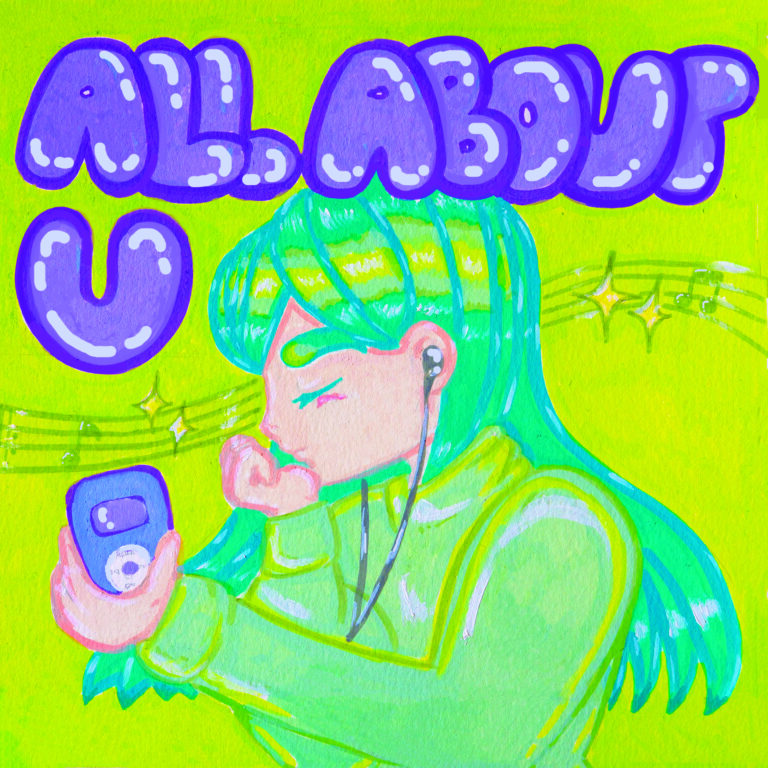
Her debut EP ‘all about u’ moves through the search, impatience and vulnerability of love across three tracks that feel genuinely fresh and yet deeply and warmly familiar. Speed garage into drum and bass, Y2K nostalgia with a 2026 heart, and every copy hand-assembled in Echo Park, packaged with unique artwork created by twin sister emipokapoka.
No algorithms here, just brilliant, joyful, emotionally honest dance music, released the way music used to feel.
melliejellie is described as an art project of reclaiming digital space, but for anyone coming to you fresh, can you explain in plain, non-technical terms what an analogue electronic project actually is and what it sounds like versus what people might expect?
melliejellie is a collaborative music and art project. The music is electronic — hyperpop-style vocal chops, UK garage, fast EDM breaks — but it’s made and experienced through analog media. It sounds like modern dance music, but you experience it as nostalgic ’90s–’00s EDM, because it’s released on hand-burned CDs and cassettes with riso-printed artwork. People expect an EP on Spotify; what they don’t expect is the DIY ethos behind the whole project, start to finish: the live bass and synths, the hand-drawn artwork, the riso printing, CD burning, cassette dubbing, sticker printing, the hand-assembled cases and booklets, and the y2k goodie bags that come with every order.
You’ve talked about y2k nostalgia and a time before the digital world became complicated. To me you look far too young to be personally nostalgic for that era, so where does that pull come from for you, and what is it about that specific moment in time that keeps drawing you back? Or have I got that completely wrong?
I was born in the ‘90s and grew up in the 2000s, back when we had a single shared family computer and no social media. My parents were very strict with video games– mostly we were only allowed to play Dance Dance Revolution (DDR), because it counted as fitness. I think about how uncomplicated my relationship with the world was then, when dancing was just something I did at home with my friends. But also, I think anyone today can be nostalgic for this period.
The EP is centred around searching, impatience and vulnerability across its three tracks. Was that emotional arc a conscious decision from the start, or did you look back at what you’d made and realise that’s what had come through?
The emotional arc was not intentional– it emerged late in the song development. Really, the music came first. I was creating music sketches and knew I hit a great track with “i won’t wait 4 u”. But the track felt lonely on its own, so I had my work cut out for me trying to elevate my other ideas to complete the EP. I will say it’s much easier to work on 3 tracks that are completely different moods than to be stuck working on the same one every day. Once I had the 3 demos, it felt natural to reflect and assign meaning to the larger project.
You’ve described the bassline as the trigger for this whole EP. Where did that bassline actually come from?
It started with “Peach” by salute & Sammy Virji, one of my favorite tracks. I was practicing the bassline on my electric bass, changing the key, pushing the bpm — really just trying to unpack the genius of what they’d made. But it started to take on a life of its own. I started to feel like I wanted to make an EP that could sit next to its inspirations on the shelf. Naturally, I bought each of their new albums on cassette tape and listened every day while I worked on the rest of the EP. Then I decided to make my own actual cassette tape that I could play alongside theirs.
‘I Won’t Wait 4 U’ starts as speed garage and turns into a drum and bass track, that’s quite a journey within a single song. How do you know when a track wants to do something like that, and how do you follow it without losing the thread?
Originally all the tracks sat at a more modest 132 bpm. Every week or so I would play the current track for one of my teachers at IO Music Academy, and they would say “you know, I bet this could go up a few bpm”. We started to joke around that every week the song would increase bit by bit, and before you knew it, it would be drum n bass. Then I decided to actually go and do that because I wanted to see the surprise on their face as they realized the bpm was going up DURING the song. I loved that. Each track was communicating its own feeling, and “i won’t wait 4 u” had the most dance-forward energy, so the bpm change suited it.
Do you work from a home studio, a recording space, somewhere else entirely, and what does your setup actually look like when you’re in the middle of making something?
I have a home studio that I’ve built out in my apartment in Echo Park, LA. All of my instruments are hooked up to my audio interface so I can play and record anything at any time. I have a ton of instruments: my Sequential Take 5, Fender Jazz bass, Warwick fretless bass, upright bass, a custom Hamsa handpan, Roland piano, a Shure mic and TC-Helicon for vocal effects, a bunch of acoustic percussion accessories from Motherland Music, Novation Bass Station II, DrumBrute Impact, Ableton Push 2, Novation Launchkey MIDI keyboards, an extensive pedal chain (Strymon, MXR, Empress, Chase Bliss).
Most importantly, there’s a cushion right below my monitor that my cats always squish together while they lazily judge my session– it keeps me motivated when I get into the nitty-gritty of an Ableton project. When I’m in the middle of making something, there will be cables everywhere as I plug and unplug different instruments into my audio interface. I usually leave my Ableton session open in the hopes that visiting friends might improve the track or fix my mix ;).
You play a number of instruments including bass. What else are you playing on this EP, and when and how did each of those instruments come into your life?
These days I think of myself as a classically trained multi-instrumentalist and producer, but I used to just be an upright bass player. I started on cello as a kid, and in middle school I got recruited onto upright bass because I wanted to join jazz band. I spent my childhood performing in orchestras — California All-State, the Colburn Youth Orchestra. Then one day in high school I visited Guitar Center, got blown away by a Warwick fretless bass, and taught myself to play it.
Years later, my teachers at IO Music Academy introduced me to hardware synthesizers and I picked up the Sequential Take 5, which I used for all the synth leads on the EP. I play electric bass on “looking 4 u” — a Fender American Professional II Jazz Bass through some pedals — but when I want a less active bassline, I use a Reese bass I programmed in Ableton. I have a few signature sounds now; that Reese, a heavily modified pad built on a Korg Trident, a synth pluck that borrows from the Roland Juno and deep house, a pitched-up sine wave from UK garage, and an orchestral-strings plug-in for that classical power. I love combining all of it with chopped emotional pop vocals and UK garage drums to build the melliejellie sonic universe.
And what is that steel drum that I’ve seen you playing on your socials?!
I was a terminally online kid, and one day, scrolling Reddit, I discovered a new instrument: the handpan. It was so new and rare back then that you could only buy one online and have it shipped from overseas for thousands of dollars. Naturally, I begged my parents for one, and when they balked at the price, I declared, “There is no price on art.” I was not very convincing, and I didn’t actually get one until I rediscovered the instrument two years ago. I found a local maker in LA, Hamsa Handpans, peppered the owner with questions about keys and modes, insisted on an instrument with a Bb note, and asked for as many notes as they could reasonably fit on one shell.
I mostly use the handpan for my other project, Sea of Diane, where I perform live ambient handpan soundbaths with cats at Tail Town, a nonprofit cat rescue in Pasadena. But there is some crossover — I love recording it through my effects pedals, especially shimmer reverb. You can hear handpan on my previous EP, “gospel for survival,” on the track “untimely meditations.”
You hand-burn every CD and cassette yourself and package them with custom artwork. That’s a serious commitment of time and energy in an era where most artists are purely digital. Why was that level of personal touch non-negotiable for you?
In many ways, this project is a public statement of defiance against the modern streaming landscape, where music and art are automated, generated, enshittified, mass-produced, and treated like another product, something that has to compete for human attention, become viral, hit impossible streaming numbers, and win the algorithm arms race. What if instead we say, ”Enough is enough, we’re taking this to the real world”? That’s why we’re really developing melliejellie as a project that centers the offline experience with printed artwork and analog media. The personal touch and process are a core feature. It’s also incredibly fun to learn all of these DIY skills; we’ve even had to repair a cassette deck! The video gamer in me is loving all the side quests in the melliejellie project.
Tell me about emipokapoka. Who is she beyond being your sister, what is her artistic world, and how did you arrive at the decision that her work was the right visual language for melliejellie?
My twin sister, Emily Minakata, who creates under the name emipokapoka, has an artistic world that is heavily inspired by the anime, manga, video games, and online experiences we had in our childhood. In many ways, it was isolating to grow up in such a neurotypical suburban neighborhood with this huge cultural difference: which was the artistic influence we were receiving through every weekly translated manga scan, every sketchy anime streaming website, every video game we played religiously. It wasn’t so much a decision as something that happened organically; just as I would start to lose momentum after finishing song production, Emi would listen to each track and start drawing art inspired by the ’90s-’00s—Tamagotchis, trolls, lofi girls with iPods. This, in turn, gave me the motivation to showcase the artwork as part of analog media—CDs and cassettes—and pushed both of us to learn new skills in our disciplines. Now the project feels inseparably linked between the music and the art.
The EP is packaged across two cities, Capitol Hill in Seattle and Echo Park in Los Angeles. How does that physical distance between you and emipokapoka shape the collaboration, and does it ever create tension or challenges?
I think it’s important to center this project in these two real-world locations, especially since Capitol Hill in Seattle and Echo Park in Los Angeles are (a) where we actually live, (b) both hyper-local creative hubs that engage in CD/cassette and riso print culture. The collaboration has been a way for us to stay connected to each other, constantly sending updates on our progress and motivating each other. The main challenge was translating her artwork to the CD/cassette packaging when the cases are physical units in Echo Park. To bridge the gap, I brought in my girlfriend, who just happens to be a Photoshop witch and owns an unusually capable printer, so Emi scanned the art, and we were able to prototype. I think we realized that actually packaging, labelling, assembling, booklet-creating— there’s a lot that goes into the CD and cassette package and is really a third discipline in this art project.
There’s a male voice on ‘looking 4 u’’. Am I allowed to ask who that is, and how you chose them to feature?
I was really inspired by Fred Again‘s Actual Life albums, which lean heavily on sampled YouTube spoken-word poetry. Trying it myself, I realized how genuinely hard it is — finding poetry that hits an emotional nerve, collaborating with that feeling, making it musical. It’s not straightforward at all. It felt natural to weave in two different “voices” from two poets. The male voice is Rudy Francisco — a wonderful poet who tours occasionally, and I’d really recommend his books. The female voice comes from “I Been Looking For You” by Jamaya Walker. Crediting them here matters to me, and it’s something I want to do right. It even inspired me to try writing my own spoken-word poetry, though I’m still pretty bad at it.
You’re reclaiming digital space and taking dancing back to dancing. How do you think the world’s appetite for that kind of pushback against the internet feels right now? Is the timing of this project deliberate?
I think the pushback against the internet is at an all-time high right now, and I share the feeling. The timing wasn’t deliberate in an “I planned this” way — it’s just a reflection of my current values and priorities.
Do you think melliejellie appeals to a specific generation, or are you finding that the y2k nostalgia pulls in people who weren’t even there the first time around?
A bit of both. I’m a zillennial, and I do think there’s a specific generation of us who grew up with the internet and feel nostalgic for things like DDR. But every generation goes through nostalgia, and now even younger people are nostalgic for a time before they were born. They might not catch every specific reference in the art, but I think they relate to the vibe.
This EP has a real sundowner quality to it; beach bar, cool terrace, late afternoon golden hour energy. Where do you actually want people to be when they hear it, and is there a specific place or moment you had in mind while making it?
While I was creating this music, I would listen to my favorite artists’ tapes on my Walkman while going on sunset walks. Somehow the music sounds much better and more immersive on the tapes, so I really do think that’s the best way to hear it. However, I also love the idea of a wholesome party to enjoy the music– I’ve been ideating on a neurodivergent friendly kickback-style party that has video games, chill-out zones, zines & art prints, tea, and DDR pads for dancing. I also love outdoor picnic-style events and would love to organize something like that too.
The EP is out on streaming platforms but also available as hand-burned cassettes and CDs. Are you finding that people are genuinely buying the physical copies, and what does it feel like when someone chooses the analogue version?
Yes, we’ve had a few pre-orders, which feels amazing! Mostly my friends have said they want the analogue version but that they don’t have a CD player or cassette player. I’ve been demonstrating by letting folks try out my Walkman and my Sony Dream Machine, and they are 1000% sold once they try it. I’m encouraging folks to buy on eBay, although I do have a few new players that I recommend linked in my bio for anyone overwhelmed by buying used. It feels amazing hearing my friends go out to thrift stores, hunting down cassette decks, and playing the CD in their cars :).
You describe melliejellie as something meant to be experienced offline. What does that actually mean in practice for someone discovering you for the first time on Spotify or Instagram?
My goal is to meet people where they’re at. I’m doing a lot of work on the ground in LA, but I started to like the idea of using social media and streaming as a funnel, like “hey! Are you sick of scrolling? Here’s a way to get offline!” I also try to bring as much of the offline aesthetic as I can to my Instagram page and Spotify page– DIY videos showing me assembling tapes, fixing my deck, playing the bass, printing CDs, etc.
If ‘ALL ABOUT U’ existed in the actual y2k era, so no Spotify, no Instagram, no streaming, how would melliejellie have found her audience, and do you think the project would have worked in that world?
I’ve actually been thinking about that a lot lately, and am trying to integrate all of those methods as well. I’m working on flyers to post around my neighborhood at night, I’m chatting with local record and print shops to see if they’re willing to carry my analog media & artwork, I’m sending the music to the DJs at my music school, I’m looking into any local print newspapers to see if they’d run a piece about the project. I’d probably figure out how to get my tracks into arcades with DDR machines as well, and throw a few parties. This has actually been really instructive for ways I can keep the spirit of promoting this project in a y2k fashion.
melliejellie is a project about reclaiming space and stepping back from digital noise, but you found me through Musosoup, does the irony of that make you laugh?
Haha, the irony does make me laugh, and I appreciate your journalistic integrity. Honestly, this is the first project I thought to promote, and I really didn’t know anything when I started. I realized folks often pay to submit to Spotify playlists in order to get streams, as well as to get some guaranteed press. I thought to myself– well, don’t knock it until you try it! I learned that some amount of this is normal for a promo campaign, so I’m being pretty open about it. As I’m learning a bit about promo, I’m trying to be a bit more selective– pay writers for a quality interview or review. I’ve also had one or two writeups, which has been a great signal that this project has legs. I’m not against Musosoup because I understand that the modern blog and journal industry is notoriously not making money– Google isn’t directing traffic to blogs, people aren’t buying print magazines– so it makes sense to pay for a write-up that otherwise won’t generate any revenue.
You’re also on Instagram and TikTok. Is there a line to be drawn, or are you having to succumb to what’s now in an attempt to create what’s for the future?
I try to be very intentional about how I engage with Instagram/TikTok. For example, even though social media algorithms often reward polarizing content, I refuse to create any content that’s made with the singular goal of algorithmic success. I don’t piggyback off of controversies or “weigh in” for clickbait or say anything that manipulates viewers into fighting in the comment section. I also don’t try to churn out as much content as possible. The content I create has to be something I genuinely enjoy creating and one that gives me the right feeling upon viewing: creativity, world-building, nostalgia, and a stable feeling.
‘all about u’ is available now on all streaming platforms, including Bandcamp, and currently features on my ‘Echoes on the Dancefloor‘ playlist.
And you can find more about the brilliantly infectious melliejellie on Spotify and Instagram, and buy her beautifully curated and created CD and Cassettes, posters and other merch here.
August 17th 2026