
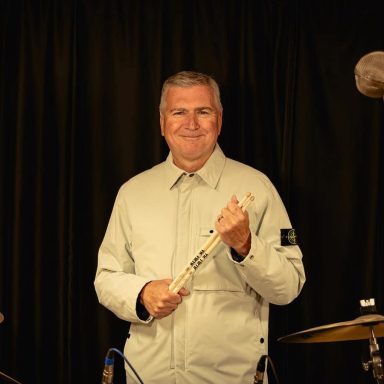
Steve White, Drummer
“Ultimately, the most important thing is the song; without a good song there is nothing.”
Fresh off the glow of Earth-O-Naut’s “Bring The Light”, I caught up with Steve White, the heartbeat behind so many era-defining British records, for a short Q&A on groove, graft and keeping the song front and centre.
It’s all that I imagined; generous, grounded and razor-clear about what really matters.
We talk opportunity, tech, and the calm confidence of a drummer who’s played everywhere and still chooses honesty over hype. There are collabs, influences, and a reminder that drums can be joy, medicine and movement all at once.
Get comfy and go with this swing.
What first drew you to the drums over any other instrument, and what keeps that passion alive decades later?
Around 8 years of age my Dad gave me a drum that belonged to his brother (my uncle) who passed away very young . He left a snare drum and some sticks and that was that, I was hooked . My Dad came home with a copy of ‘Let There Be Drums‘ by Sandy Nelson and it’s sound blew me away.
You’ve been part of some of the most defining sounds of British music, from The Style Council to Paul Weller, The Who, James Taylor Quartet, Trio Valore and The Family Silver. What pulls you to a project – the musical genre or artists involved? Or something else?
Once you are established it’s usually word of mouth or recommendation by friends or colleagues, the hard part is getting that door open in the first place, getting established,. For me, it was endless auditions until a band, who I didn’t work out for, told Dennis Munday at Polydor records that they had seen a young drummer who was a bit Jazzy just on the day he was looking for a jazz inspired drummer for the Style Council.
You’ve worked with musicians across generations. What’s the most valuable lesson collaboration has taught you?
Just play for the song. It doesn’t really matter beyond a certain point how good your technique or soloing skills are if you can’t play in time or play with feel and taste, and you can get on with people socially too.
The Style Council was known for its
social and political consciousness. Does that still shape how you approach music and the industry today?
I try to still be a decent person, the music business has changed much, politics have changed so much too. I am still a believer in Scandinavian style socialist principles, but have learned to accept that Britain isn’t going anywhere down that route. I am incredibly worried about the political system in our country and still believe for me the best government for the likes of me growing up without the privileges of class was the first post war government led by Clement Attlee.
There’s a very distinct “Steve White” sound, an empathy to the melody and crispness that’s often instantly recognisable. How would you describe your drumming philosophy?
Try to understand what the writer or the musicians want, ask about the lyrics, what’s the song about? You would be amazed at how many drummers never even bother to ask what’s a song actually about. I will also ask if there are any influences required, soulful, funky, Ringoesque!, which all influence how I approach playing.
You’ve seen the shift from analogue recording to digital, vinyl to streaming, and now back to some of the original channels. Has technology changed the way you play or think about music?
I love the freedom that technology gives to musicians. It’s actually very cheap to make great quality music, the problem is getting it heard, finding places to play it live and making money from it .
How do you prepare mentally before a live performance versus a studio session?
I try to remain as fit and healthy as I possibly can in terms of exercise, diet and well being, I try not to dwell on excessive negativity, I still practice as much as possible and will always try to be as prepared as possible to play in terms of learning the song or piece I am required to play on.
Looking back on all of the projects and gigs you’ve been involved in, is there one that truly stands out for you?
I am lucky to not be able to answer that specifically; the first years of the Style Council, the first three Paul Weller albums, the whole vibe in London during the acid Jazz years, sharing a stage with Ian Dury and Amy Winehouse, touring America with Oasis and the Black Crowes, playing to 40,000 people in a square in San Paolo with Jon Lord, touring Italy with the Trio Valore, contributing to 4 series of “The Madame Blanc Mysteries” with Chris Hague as the team behind the music, hopefully a fifth series soon, Live Aid, Live 8 with the Who, “The Art Of Drumming” TV series winning an NTA award, being part of a successful drum academy for 25 years (Freddie Gee) and even now working on a solo album with touring next year, and also getting to play with Earth-O-Naut and Lucca Mae on their albums, both fantastic new talents.
You offer workshops and online challenges in learning the drums. Who do you find comes to you to learn or improve?
The online thing I realised doesn’t work for me. It’s usually experienced or working drummers that have hit a wall. Sometimes the success of the sessions is not even drumming just unblocking channels preventing progress.
How do you balance technical precision and theory with emotional feel?
Very carefully. Most of the drummers I truly admire have that killer combination of time, taste, touch and technique; get that blend right and you are a good way down the line.
You’ve played in everything from soul to jazz to pop. Is there a genre you’ve never tackled but would like to?
No not really, I am ultimately a fan of songs. There are artists I would love to work with, Kate Bush, Khruangbin (but they have a great drummer), so as long as I get to play on good tunes I’m happy.
The drum kit has such a physical presence, on stage and in the studio. Do you find your relationship has evolved with it over the years? Do you have a particularly favourite kit or piece?
It is a physical presence and good technique is paramount. Some of the true greats, Louie Bellson, Roy Haynes, Art Blakey, were still doing it into their 70’s and 90’s, in Roy’s case, so I take my lead and influence from those guys.
How did you get involved with Earth-O-Naut, and what drew you to
working with them?
I think Terry was a teenager when I first met him and we have just always remained friends. He was originally more exclusively a drummer but branched into production/writing/ multi instrumentalist as time went on, We had his band ‘The Universal’ with Trio Valore, but even back then he said he wanted to do something more soul influenced, and when he did luckily he called me!
Did you listen to the tracks first and then instinctively find a drumming flow, or do you prefer a more prescriptive approach?
Lots of listening, lots of preparation, I have a beautiful selection of vintage and modern drums and cymbals I can pull into a session, luckily on these songs I had Chris Hague producing my contribution as we were recording for the Madame Blanc Christmas special so we were already in recording mode , we took a day and just did all the tracks.
You’ve worked with some real legends. Has there ever been a moment where you’ve thought “I can’t believe I’m in this room”?
I don’t really get fazed by people, but it was wonderful to meet Art Blakey, Elvin Jones, Louie Bellson, Buddy Rich, Ginger Baker, Charlie Watts, Ringo all in person, but my wife, Sally, said the only time she saw me star struck was when I met Barbara Windsor.
There’s a lot of talk about the connection between drumming and mindfulness. Do you find drumming meditative?
Absolutely, especially during the madness of lockdown, every culture and a lot of religions (well the cool ones) use drums; drums are healing, therapeutic, cardiovascular and fun.
What’s next for you musically? Any other projects or collaborations you’re especially excited about that you can share?
As I mentioned, just finished a fantastic young singer called Lucca Mae‘s album, very soulful. I have a couple more Earth-O-Naut songs to do, Chris Hague and I just finished the Madame Blanc Xmas special for Channel 5 / Acorn TV, hoping to get the go ahead soon for another series, and I have been working on a very funky organ instrumental album with Chris and Joel White with dates in April and May next year, including the 229 Great Portland Street in London at the Mods Mayday with Eddie Piller.
Finally, a bit of a cheeky one… who’s the most important facet in a band? The singer, guitarist, bassist, or drummer, and why?
As Buddy Rich said “a band is only as good as it’s drummer.” I subscribe to that philosophy, unfortunately that seems to go against the grain of modern thinking where a lot of bands drummers are quietly anonymous. I hope that changes, we need a few more personalities out there. Ultimately, the most important thing is the song; without a good song there is nothing.
Huge thanks to both Steve White and Earth-O-Naut for making time for these interviews.
You can discover more about the projects Steve has been
involved in on his website.
And give your ears a gift by listening to ‘Bring The Light‘ on Spotify, as well as other streaming channels.
Follow Earth-O-Naut on Facebook and Instagram, and if you missed my exclusive interview, read it here…
heello