There are interviews you conduct that remain firmly fixed in your mind long after you’ve stopped asking the questions.
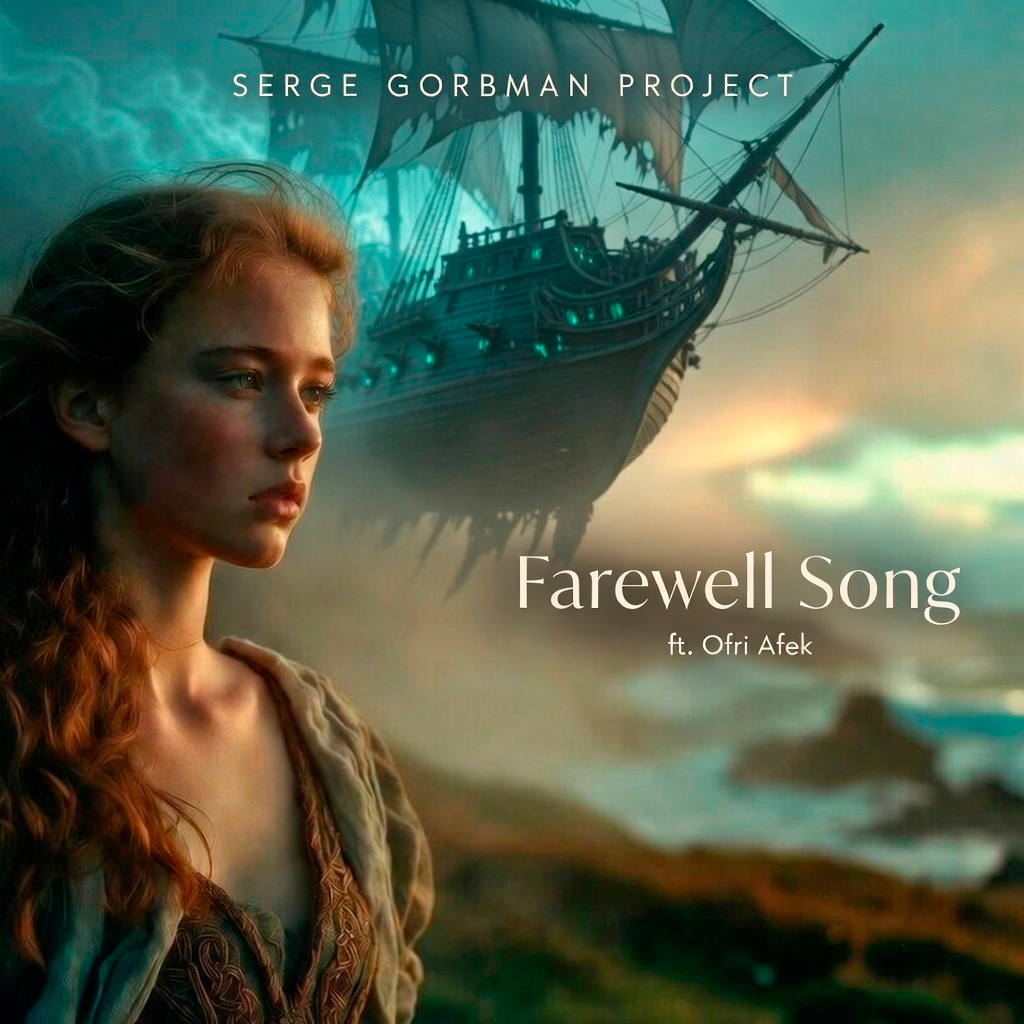
Serge Gorbman is a producer, audio engineer and composer who has spent over twenty-five years working in the quiet service of other people’s visions. ‘Farewell Song’, his debut release under his own name, has been more than twenty-five years in the making, not out of hesitation, but out of an absolute refusal to release it before it was truly ready.
The track itself is cinematic, layered and unhurried, but it is Serge’s mind that is the real revelation here. He quotes Chekhov, Pasternak, Toni Morrison, Charlie Parker, Wong Kar-wai and John Fowles in the same breath as talking about Spotify algorithms and TikTok’s twenty-second attention span. He is, in the very best sense, completely uninterested in bending to the world.
What follows is one of the most thoughtful, surprising and genuinely philosophical conversations I have had with an artist.
‘Farewell Song‘ has been living in your creative memory for twenty-five years before this recording. What kept bringing you back to it and what finally made you say “now is the time”?
Actually, 25 years ago, the song was already recorded, but it didn’t achieve recognition. Back then, I felt I simply hadn’t managed to unlock the true potential buried inside it. I also realized that achieving that would require something far beyond standard rehearsals or mastering the latest software updates. Instead of looking for outside vocalists, I decided to open my own vocal studio to cultivate the exact voices I needed. After a lot of trial and error, it became clear that I had to discover talented children and bring them up to the necessary professional level. Many dropped out along the way; only a select few remained.
On the other hand, I desperately needed to poetize the entire musical process. Most of my musician friends operated strictly within musical terms, and I felt suffocated in that narrow world—it lacked the solution I was agonizingly searching for regarding Farewell Song. The breakthrough came from an unexpected place. Out on my morning runs, as always with my headphones on, I began to notice that the music I listened to format-free and continuously was suddenly getting in the way of my running. It was bizarre. After struggling with this for a few days, I started testing other options: changing styles, genres, listening to prose, poetry—nothing worked until one fine day, purely by intuition, I decided to memorize a short poem by Boris Pasternak on the go.
A few years passed, and I knew about a hundred of his polyphonic poems by heart. By analyzing and constantly repeating them so as not to forget, I discovered that very poetic universe that allowed me to see the necessary depth, which ultimately led to the birth of the song’s new version. I am convinced that even mastering modern recording technologies often fails to yield a solution. You need an additional degree of freedom, and for me, that is the metaphysical component of the world—the secret weapon without which all modern recording tech remains just a heap of hardware and software.
The time between the original creative theme and the finished track is 25 years. When you listen to Farewell Song now, do you hear the composer you were then, the producer you are now, or something of a total fusion?
I feel a deep, tender respect for the person I was 25 years ago. I cherish the energy and the talent poured into the original composition, but only now do I see how complex and winding the path was that led to a true understanding of this song. One must always move forward, never fear the new, strive for harmonious self-development, and trust that in the end, everything will fall into place at the right time, when all conditions have matured.
You found Ofri Afek at eighteen years old to be the voice of this track. Where did you find her and how did you know she was the one? What does she bring that a more experienced vocalist might not?
One of my intuitive decisions was establishing my own vocal class to essentially grow the exact sound I needed. Ofri came to me when she was 12 years old and completed a full 6-year course in vocal technique, performing in numerous local concerts. She beautifully hit the exact intersection of modern recording technologies and a metaphysical understanding of the creative process. When I saw these three components align, I knew: the time for recording had come.
The lyric “the producer is standing undoubtedly blind” feels like it carries a very pointed meaning in 2026. Is that line a piece of social commentary, or is it something more personal, and did it mean the same thing when you first wrote it as it does now?
The lyrics were written by the poet and theater actress Ilana Marmorshtein. Brilliant, witty, and never discouraged, Ilana wrote this while going through a deeply personal drama. But, as it often happens with true poets, she saw another layer to it—a grander canvas where the actions of specific, respectable figures receive a proper evaluation through the eyes of a poet. Witnessing what happens around us today, anyone can surely appreciate the strength and accuracy of that phrase. By the way, Ilana and I wrote three songs together back then, and the second one from that archive will be released soon—a modernized and reimagined track titled ‘Moody Melody’.
You’ve described Farewell Song as a piece from an unmade film or an un-staged theatrical play. Do you have a specific visual world in your head for it, a setting, a story, a character, and if so, what does it look like?
It would be more accurate to say that the song was written in the footsteps of an unread book. Meaning, I wrote the song first, then spent a long time reflecting on what it all meant, and when I finally read The French Lieutenant’s Woman by John Fowles, I instantly recognized the heroine of the song. Much like Sarah Woodruff, she comes to a high cliff every day, staring out at the sea in hopes of spotting that one specific ship. The sea, initially calm and carrying foreign vessels across its waves, grows increasingly menacing until, in the end, the wreckage of that very ship washes up against the cliff. And her heart instantly knows it is his.
An interesting moment is tied to the violin solo in the middle of the song. It represents a moment where, on one of the passing ships out in the raging sea, we spot a violinist on deck, masterfully executing that solo. A violinist delivering a tragic message to the heroine on the cliff.
You’ve spoken about Spotify promoting unimaginative background music and TikTok teaching people to judge art in twenty seconds. As someone who makes music that is really immersive, how do you even begin to navigate those platforms without compromising your work?
Yes, the reality is such that the graduates of the “TikTok Academy” possess this unique 20-second judging ability, while Spotify’s psychotherapeutic “mood playlists” should probably be evaluated by purely medical criteria. Even at the dawn of my musical career, I saw a blatant misalignment between a genuinely creative approach to the craft and a conformist stance that caters to mass taste. Being a fierce advocate for the former, I received a timely, evergreen piece of reassurance from the chorus of a rock song popular at the time: “Don’t bend to a changing world—better let the world bend to us.” Not much has changed in essence since then. Time has proven one thing: this changing world is excellent at bending, or as they say today, pulling a complete U-turn mid-air. So, the destiny of platforms is to bend and transform. Our task is to understand exactly who we are dealing with and focus on creation.
Do you think the appetite for genuinely cinematic and emotionally ambitious music is growing or shrinking right now, and where do you see the people who are hungry for it actually finding it?
People love listening to OSTs (Original Soundtracks), but that is music tied to known films; it connects directly to the visual experience gained while watching the movie. Farewell Song is music that bypasses standard categories. It is tailored for music supervisors, theater directors, or figure skating choreographers. In a way, it’s a raw, high-potential material.
But there is also a massive group of people with highly developed imaginations, people with “non-playlist” minds who are open to the new and completely devoid of cookie-cutter judgments. The fact that they aren’t unified under one banner is actually a good thing—who knows what would happen if they did? It’s a bespoke market; even though there are many such individuals, they are scattered across the globe without any direct connection to one another.
You’ve spent over twenty-five years working behind the scenes as a producer and audio engineer. When did you decide the music you were making deserved to be heard under your own name rather than in the service of other people’s visions?
This is a deeply personal question for me. In the environment where I grew up, music was never considered anything more substantial than a hobby. The ironclad arguments of the opponents of this profession didn’t derail me, but they did force me to keep my involvement under wraps as much as possible. Anton Chekhov once wrote, “One must squeeze the slave out of oneself drop by drop,” and that is precisely what I did. The process took a long time, but it concluded successfully only very recently. It might sound funny, but it is what it is.
You use modern digital tools to achieve what you’ve described as a human-led hybrid production style. Where exactly is the line for you between technology serving human expression and replacing it?
That is an excellent question! To paraphrase a famous saying: for great questions, great answers do not exist. The world is complex. The art that reflects it should, by design, be complex, multi-layered, possessing different dimensions and interpretations. George Martin understood this perfectly—his work with the Beatles sounds complex, and even today, it is pure magic. Read up on John Lennon; he despised simplicity, yet he possessed the unique ability to handle the complex with ease.
In my view, the sheer genius of the Beatles, who never had any formal classical training, lies entirely in their metaphysical perception of the world. It’s an extra dimension that is either accessible to you instantly or forever closed. It is only with this extra dimension that one can approach the fine line of expanding creative consciousness. I am not talking about replacing human expression, or even merely serving it. To me, that might be convenient or even useful, but it is utterly uninteresting, and I have no desire to waste my time on it. We can only talk about expanding creative consciousness. But for that, you have to be initiated—you need to have a polyphonic Pasternak behind you and know how to process musical data metaphysically. That is when hybrid instruments come alive. The true standard of excellence kicks in, and the result completely captures the imagination.
‘Farewell Song’ is layered with strings, orchestral arrangement, vocals, piano, and Celtic folk urgency, all precisely balanced. Can you walk us through how a track like this is actually built? Where did you start and how did you know when was finished?
In jazz, pianists play incredibly complex chords by visualizing them as the shape of a flower. They don’t build chords scale-degree by scale-degree, nor do they stress over inversions; they simply memorize the form. And that form is inextricably linked to an emotional sensation. Meaning, you play by feeling. Wong Kar-wai directs films where the core is not what actually happens between the characters, but rather the heavy sensation of a love that never came to be, of loneliness, of slipping time.
During the arrangement process, Farewell Song was never just a story about parting; it was an effort to construct a cinematic sensation—the prolonged intro, the orchestral textures, the Irish violin, the slow-burning build—an atmosphere that stands above the events themselves. It is vital to reach a level of absolute trust in your own sensation. It’s just like love: you can break it down into chemical compounds, but the only outcome will be a slight advancement in the field of chemistry. A real result cannot be achieved through student-like, textbook methods. In short, it is a non-linear process. The logic is grounded entirely in your ability to remain in a state of flight. Everything else falls into place automatically. I doubt this serves as a conventional explanation, but it is the absolute truth.
You’ve described your goal as bringing this music to the theatre stage or the cinema screen. Are you actively pursuing those conversations right now, and what does that pathway look like for an independent artist in 2026?
While registering the rights for Farewell Song, I took the opportunity to test out several music promotion platforms—Groover, Musosoup, and SubmitHub. It was a useful exercise that gave me a crystal-clear understanding of how other people perceive the stylistic choices embedded in the song. Now, I am ready to step into proper music libraries, such as Songtradr and Crucial Music. This is a vast territory, and I intend to dive into it headfirst.
The ending of Farewell Song is deliberately unresolved, no fairytale conclusion as often happens or is expected. Was that a creative decision made early, perhaps for a particular placement in a show or film?
I have always been fascinated by books that seem to end in nothingness. But this ambiguity is an illusion, and it is highly effective. You just need to invest heavily and lay the right groundwork for such a “denouement.” Life is multi-faceted, so let the audience wonder what actually happened and share their own thoughts on the plotlines. It’s far more interesting to spark the imagination and let listeners bring their own interpretations to what they hear. Interactive creativity—that’s what I call this approach.
I once knew a jazz saxophonist who taught a course titled “How to Conduct Modern Business” based entirely on the concepts of bebop improvisation. His whole philosophy was to trigger associative thinking combined with a rapid cycling through all possible combinations.
Is there a broader creative vision behind that process, an album, a collection, or a complete world you’re working toward?
My concept is to flip the traditional idea of a seasoned actor who, after decades of training and work, manages to keep their inner child alive. Instead, I want to take that literal youth, train them, hand them complex, mature material, and find the perfect equilibrium between their raw freedom of expression and the required level of technical mastery. The end goal is a pure synergy of quality. Creative collaboration across generations—that is what genuinely intrigues me.
Is there a piece of music, a film score, a stage production, that exists now that you can point to and say “that is the territory I am working in”?
I love it when the realization of a director’s vision—or more accurately, their sensation—leads to a monumental result. Take Charlie Chaplin’s The Kid, for instance; the masterclass way he intricately placed a child into a deeply complex context is my ideal representation of the territory where I feel most at home. It’s not as simple as it looks, and I know exactly how those gears turn behind the scenes.
Sergei Dovlatov wrote in his diaries about the necessity of creating an artificial obstacle—a technical constraint—to stimulate creative energy. He referenced Georges Perec and his 1969 novel La Disparition, written entirely without the letter “e”—the most frequent letter in the French language. Dovlatov himself consciously avoided starting adjacent words with the same initial letter. Looking at it through this lens, it becomes perfectly clear why Chaplin fought so hard to defend silent cinema; it was his own form of creative limitation. For me, working with the younger generation on incredibly demanding material is that exact type of challenging constraint that forces you to discover entirely unexpected solutions.
What do you look for in a collaborator, and was working with someone as young and instinctive as Ofri a different creative experience to working with more established performers?
When working with professional, established performers, I can instantly see their rigid training, their artistic clichés, and the strict comfort zones that they value so highly. But in my eyes—though I never say it out loud—that rigidness is precisely their main flaw. Perhaps at the absolute highest tier, a performer is capable of doing what Charlie Parker once said—“Forget the chords and just play!”—breaking free from patterns to deliver something raw and fresh. But I have yet to encounter such performers in my path.
You clearly hear music cinematically, in scenes, in images, in narrative. When you listen to something completely outside your own genre, a pop song, a piece of jazz, a folk track, do you instinctively start reimagining it as a film score? And if so, what’s the last piece of music that did that to you?
As Toni Morrison beautifully put it: “If there’s a book that you want to read, but it hasn’t been written yet, then you must write it.” That is exactly why I write songs—because it constantly feels to me like music out there is falling short somewhere. But when I see how powerfully music can be embedded into a cinematic context—Danny Boyle’s 2019 film Yesterday is a brilliant example—it is truly exhilarating. That said, there are two genres where I completely forget about cinema and just listen: traditional folk music from different cultures performed by modern musicians, and jazz in all of its improvisational shapes and forms.
Twenty-five years is a long time to carry an idea. What else have you been carrying for that long, and do you think it will ever be released?
Beyond bringing these archival songs to life, there is another major project. I have composed about 50 melodies based on Mother Goose rhymes, and my goal is not only to record them but to publish beautifully designed sheet music books for piano. I have also written around 100 original pieces for piano—technical and thematic etudes, compositions of varying difficulty across multiple genres, as well as arrangements and covers of classical and jazz standards. There is an immense mountain of work ahead.
‘‘Farewell Song’’ is available now on all streaming platforms and currently features on my ‘Echoes In The Groove‘ playlist.
And you can find Serge on Spotify, Instagram, YouTube, and SoundCloud.
July 14th 2026