Last Train Home Festival 2026: More Than Just Music
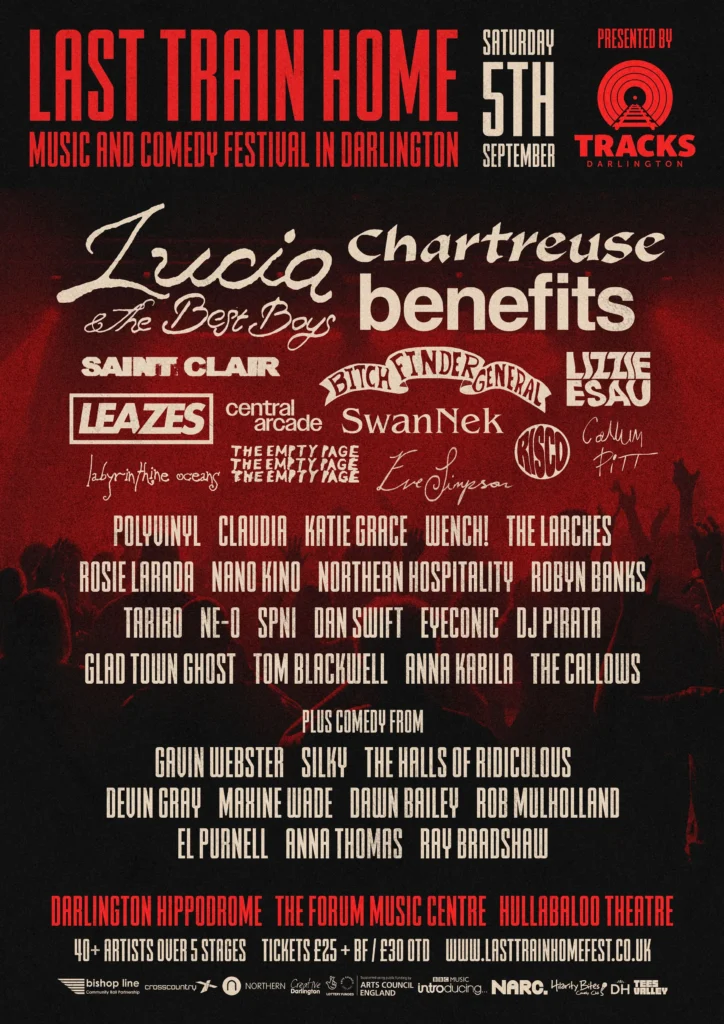
Last Train Home is generally thought of as a one-day music and comedy festival, but it is actually so much more than that. Yes, Saturday brings the big multi-venue takeover of Darlington, but the story started two days earlier, in the rather different surroundings of Hopetown.
Last Train Home Express opened the festival on Thursday evening with The Mist Calls, Staithe, who stepped in at the last minute when Before Close became unavailable, and headliner George Boomsma and his band. It wasn’t the best of nights weather-wise, the sky was darkening and rain looming, but inside Hopetown there was a gentle hum of conversation, anticipation and appreciation that suited the evening perfectly.
Tracks‘ Sarah Wilson opened proceedings, thanking everyone for coming and returning throughout the night with little pockets of information about what both the evening and Last Train Home represent. Tracks Darlington CIC exists to support grassroots music and artists in the Northeast and beyond through events, workshops and mentoring, and that ethos would become increasingly evident as the festival unfolded.
Twins Millie and Joe of The Mist Calls took to the stage first, their voices pairing beautifully across a hushed room. Threads of nature weaved through their set alongside acoustic and electric guitar, the harmonies delicate but assured. Speaking to them afterwards, it was lovely to hear just how much their connection with nature influences their music and songwriting. For musicians so young, they are already carving out a distinctive niche of their own.
Staithe followed, Bridie and Nick creating something altogether more haunting through Bridie’s vocals and Nick’s electric violin. A few technical issues unexpectedly delivered an alternative version of one song which, as Bridie admitted afterwards, she perhaps preferred; sometimes pressure creates something you couldn’t have planned. Then came their tribute to the late Dolly Parton, a beautiful and distinctive rendition of ‘I Will Always Love You’. Poignant, understated and played beautifully. If you missed it, you may get another opportunity at the end of September when Staithe play The Old Coal Yard in Newcastle as part of the Mountain Girls event series.
George Boomsma and his band brought another shift in energy, performing songs from his recent album ‘The Bracken and Tread’, newer material and a Bob Dylan cover. The evening had gradually travelled from the lo-fi intimacy of The Mist Calls, through the wistful, haunting world of Staithe and into something much more upbeat, driven by folk guitar, drums and a band clearly enjoying themselves. George bounced from track to track as feet tapped, heads nodded and whistles came from the audience. A magical a cappella piece nestled amongst the more energetic material provided some beautiful light and shade, while guitarist Will Looms at times made his instrument sound almost like an additional vocal layer. Even after an encore, the room wanted more, and the levels of applause, whistles and shouts said plenty about the support for George and his band in the room, from established fans to those newly converted and seemingly quite happy to have boarded the Boomsma Express.
Hopetown proved to be the perfect setting, its cafe becoming an intimate live venue for the night, with the team looking after drinks, lighting and everything in between. Last Train Home Express felt exactly as it should; a taster of what was coming, and what was coming was considerably less gentle.
Saturday: doors open, energy rising
By Saturday, the energy was through the roof before anyone had even taken to a stage. My day began backstage at Darlington Hippodrome talking to Glad Town Ghost ahead of his opening set in the theatre. It’s a stunning space and one that could easily overwhelm a musician not quite up to the task. Luckily, the Last Train Home team of Sarah, Rob and Fran, alongside programming support from NARC Magazine, BBC Introducing’s Shakk and the team at The Forum, had clearly thought carefully about who belonged where.
Dale, aka Glad Town Ghost, opened the Hippodrome beautifully, his superb guitar work sitting alongside lyrics that can sometimes feel almost at odds with the music carrying them, giving his songs another layer to uncover. The set included forthcoming track ‘England in Hurricane Season’, latest release ‘Exam Papers‘ and more familiar material, with heartfelt dedications to his daughter, parents and children everywhere alongside the subtle humour of ‘Redcar Shoe Shop Dream‘ and its nod to Charles Clinkard (IYKYK). It was an opening set full of personality as well as excellent musicianship as expected.
Then began what would become the recurring theme of my day; the dash between venues.
At the Noisy Daughters stage, Anna Karila and Josh Atkinson paired Anna’s acoustic guitar with Josh’s electric sound, adding weight to her sonic creations without ever overwhelming her vocals or their harmonies. They casually revealed that they’d had just one rehearsal that morning; had they not said so, I doubt anyone in the room would have known. Live music, however, likes to remind everyone that anything can happen. Part-way through the set a string snapped on Anna’s guitar. There were shouts of encouragement from the audience, not least from ‘guy in the dark’, aka well-known grassroots supporter Tim Dredge, while Josh calmly helped keep things moving. For a couple of songs Anna concentrated on vocals while Josh carried the guitar before the Hullabaloo team found a substitute guitar, the interruption somehow making the set even more memorable. They finished with their stunning version of ‘Wild Horses’, which I’d previously heard at an acoustic set at Angels Cut in Darlington and which still gives me goosebumps. By the end, the packed room was in raptures.
Back at the Hippodrome, Rosie Larada brought a completely different mood. Chilled, lively and full of bright pop energy, her fresh vocal was joined by a band clearly enjoying the space and a saxophone bringing some serious funk into proceedings. She finished with latest single ‘Look My Way‘ before we sat down afterwards to talk about finding joy in performing solo, new music that is on its way and the peculiarities of performing on a theatre stage. Rosie loved the experience, although she did say that the solid stage floor didn’t give the bass feel that she was used to; something to broaden her experience.
Then came one of my discoveries of the festival. I was already midway through reviewing Nano Kino‘s new EP ‘Object A‘, so hearing many of those tracks live felt slightly serendipitous. They’re not a new band, but they seem to be steadily creating their own space, and deserve to. Nano Kino aren’t a band who need to leap around a stage, they let their songs do the work. Their lyrics often reveal something other than their first impression and provide plenty of fodder for the grey matter, while Sarah Suri’s ethereal vocals float with remarkable clarity over guitars and drums. Duncan Lloyd and Tom English brought their anticipated hints of Maxïmo Park into the sound, with Phil Morgan’s excellent bass completed the band’s sound, earning the rights of a room close to standing room only. There were a couple of those tiny live-music hiccups again, but I rather like them. Most of the audience wouldn’t know unless somebody mentioned them, and they remind you that what you’re watching is happening right there, in that moment.
Next: big cars, punk feminism and everyday observations
Back at the Hippodrome, I finally got to see Katie Grace live after interviewing her a few months ago. With her band travelling up from London for the festival, Katie arrived sporting a statement new haircut and an equally statement-making pink guitar with gold glitter, and songs that pair perfectly. There was humour alongside much more serious commentary, feminism alongside zebra crossings, and a particularly memorable song inspired by ‘big cars’. I’ll leave you to discover the rest of that one yourself, but suffice to say it creates some space for women to step forward and push back against some very familiar patriarchal tropes. For Katie, returning to the North East with the band also carried significance; it was their first time back since recording her EP after securing funding through Sunday for Sammy. She too loved playing the theatre, although the sloping stage apparently isn’t one to attempt roller skating on. You’ll have to listen to our interview for that story.
Wench were next, an all-female punk band mainly from Hull with a little bit of Leeds thrown in, and they brought a ferocious amount of energy with them. There was plenty of conversation with the audience, making it very clear what the band stands for and what people entering their space should expect. They explicitly called for that space to be safe for everyone in the room, something clearly central to their values. And then there was Kit. How anyone drums with that level of intensity while singing at the same time remains beyond me, particularly while also battling a microphone determined not to stay where it was put, yet they simply powered through. Whoever said punk was dead clearly hadn’t met Wench.
That seemed to become a bit of a theme of the day. Strings breaking, technology refusals, and wandering mics, and yet the musicians adapt and carry on because there is an audience standing in front of them; no ego, just get on with it.
Robyn Banks was another artist I’d been waiting some time to see. I’d missed earlier opportunities over the summer and had heard plenty about songs built around everyday observations and a willingness to say things exactly as they are, my expectations were therefore fairly high. And they were absolutely met. One of the things that immediately fascinated me was the use of recorded audio to introduce some of the songs. We talked about it afterwards, and Robyn explained that reactions at different venues around the UK haven’t always been the same, so those introductions can help establish the context and prepare an audience for what’s coming. Musically, the set moved between stripped-back acoustic moments, jaunty indie and funky pop, with Robyn’s smoky vocal sitting beautifully against a band who were clearly having a great time themselves. ‘But I’m a Cheerleader’ brought a particularly funky beat and showcased that voice brilliantly, while ‘I Want to Dance with Rachel’ is well worth seeking out for yourself. A sadder ode to a friend named Anna brought another emotional turn before ‘Oh Girl’ closed the set, accompanied by a small smile of connection between Robyn and the band. This was what I’d been hoping to see.
And then the rooms got louder
Polyvinyl were next to hit the Noisy Daughters stage, bringing the surge of energy, humour and theatricality that makes them so much fun to watch. There was keyboard player Chris’s departure-not-departure, cliffhanger moments and the sense that you never quite know what is going to happen next, in the best way. I first saw Polyvinyl live at Kendal Calling this year and could happily watch them again and again They’ve worked incredibly hard to build the traction they’re now getting, attracting new fans and wider recognition, and by all accounts some rather excellent new merchandise too. Annabelle fronts the band with an almost inexhaustible energy, but beneath all the fun are excellent vocals, slick songwriting and a band capable of delivering the whole thing. If they aren’t already on your list, put them there.
My first venture to The Forum was to bathe in the pure bouncing joy of Leazes. I confessed during our video interview that I’d never previously managed to catch them live, despite hearing A LOT about their shows, and now I totally understand the chat . From the start, Sam, naturally wearing his signature kilt, built the energy before Joe entered and somehow took it up another notch. There was maximum movement, a headband working almost as hard as its wearer and brilliant interaction with a packed room. What was interesting was the balance; much of the band remained relatively static, clearly enjoying themselves, while Sam and Joe ricocheted around the stage. Rather than making the performance feel uneven, it worked perfectly. Eventually the audience became part of the stage too. Catching Sam and Joe afterwards, neither had lost an ounce of that energy. They talked about wanting to bring joy and love into the world, giving people a period of time in which they can forget everything happening outside the room. Looking at the faces in The Forum, they’d achieved exactly that.
A quick flit to the NARC stage meant I caught only the back end of Bitchfinder General, which appeared to have been full of humour, tongue-in-cheek delivery and enormous fun. I was slightly gutted not to have seen the whole thing. One for the next-time list.
Music may have dominated my own route through Last Train Home, but it was only part of the programme, with comedy running alongside it throughout the day, thanks to Hilarity Bites. I have to confess that despite every intention of catching some, the increasingly frantic dash between music stages meant I never actually made it into a comedy set. If anything, that probably says something about the challenge, and joy, of a festival like this; there is simply no way to see everything. The comedy brought another dimension to the day and another audience into the festival, even if on this occasion I had to leave that particular part of Last Train Home for others to enjoy.
Why festivals like this matter
I’d intended to capture more audience reactions throughout the day. In reality, there was barely enough time to move between stages, never mind persuade people to sit down and talk. What I did hear repeatedly, though, were conversations about artists people had just discovered and praise for the people behind the festival. I did manage to pin down Tim Dredge, familiar to many across the North East live music circuit and a tireless supporter of grassroots music. Our conversation moved beyond simply whether we’d enjoyed the day and into why events such as Last Train Home matter. We talked about regional and national grassroots music, women within the industry, under-represented communities and the role organisations such as Tracks can play in making space for emerging artists. That conversation reflected something I’d already been hearing from the stages. There was a statement being made throughout this year’s festival about who gets to occupy these spaces. Many of the artists themselves understand that progress is being made while also recognising how much further there is to go, and are prepared to use their own position to make room for whoever follows.
Then we both dashed off to see Swannek.
By this point the day had been relentless. There had barely been time to stop and stuff my face with something from Falafel Man, so Swannek arrived at exactly the right moment. Their jazz and soul-infused musicianship provided a reset, offering that intangible connection that happens between musicians who understand each other so instinctively that the performance seems to move under its own power. It was disappointing that the Hippodrome wasn’t more full, but that exposed one of the strange contradictions of a multi-venue festival with such a packed programme. Some smaller rooms were rammed while the theatre remained considerably calmer. There were simply too many good artists playing simultaneously for everybody to see everybody. For a while, though, that theatre became an oasis in an otherwise gloriously bonkers day.
Next door, the pocket rocket that is Lizzie Esau was doing quite the opposite. Fans were up and dancing, the band were clearly enjoying themselves and new material sat alongside songs that plenty in the room already knew.
Then it was back to The Forum for Benefits. I’d heard enough about them to know I couldn’t let the day pass without squeezing them in, even though time was getting tight. I’d also heard rumours about a certain tendency towards stage invasion, although ‘invasion’ might be the wrong word. With Benefits, invitation seems more accurate, and that connection between Kingsley, Robbie and Shakk was apparent as soon as Shakk appeared, with the audience more than willing to join in, with call and response bouncing around the room with immaculate timing. Benefits are known for social and political observation and there was no dilution of that here, with chants, cheers and responses coming back from a clearly committed following, and it’s not difficult to understand why.
Stories behind the songs
Dragging myself away from Benefits, it was back to the theatre for Chartreuse. Again, this was a band I’d heard plenty about but hadn’t previously seen live. Their blend of indie rock, folk and soul was beautiful, but what stayed with me most were the time between the songs. Artists don’t always reveal what their songs mean or where they came from, preferring to leave listeners to find their own interpretation. Mike and Hattie did something different, they opened the door to their creative world and shared some of the stories behind the music. Some were deeply personal, some, incredibly moving, and there is something quite extraordinary about sitting listening to someone entrusting a room full of people with an experience that has shaped a piece of music. It changes the relationship between performer and listener, even if only for those few minutes, and for that, I thank Chartreuse. I was sorry to leave before the end, but there was one final dash to make; Lucia and the Best Boys were waiting on the Noisy Daughters stage.
The room was full and stayed firmly on its toes as the band worked through their back catalogue, accompanied by plenty of interaction from Lucia. There were flashes of Fleetwood Mac and Christine and the Queens for me, while Lucia’s vocal rose effortlessly above the excellent musicianship around her, the crowd a continuous bib and sway throughout.
More than just a line-up
Somewhere amongst all of this, I realised one of my favourite things about Last Train Home had very little to do with who was officially playing where; it was the fact that the artists were watching each other. Not popping in for thirty seconds to be seen, actually watching, and having a great time.
I spotted Staithe at numerous stages, Robyn Banks and band were out catching Leazes and other sets with Rosie Larada, Anna Karila and Josh Atkinson appeared more than once. And I think that makes a huge difference. Because Last Train Home isn’t simply a collection of artists arriving, playing their allotted time and disappearing again. For one day, Darlington becomes a little ecosystem of musicians, audiences, promoters, writers, photographers, venues, volunteers and people who simply care about live music. Thursday’s gentle beginning at Hopetown and Saturday’s frantic dashes between the Hippodrome, Hullabaloo and The Forum couldn’t have felt more different, but the same thing ran through both; people supporting people.
There may have been snapped strings and wandering microphones, some sets I caught in full, others I only managed to glimpse, plus there was an entire comedy programme that somehow escaped me altogether. Rooms so packed you could barely move and a beautiful theatre that offered somewhere to sit, breathe and listen when needed. There were artists I’d waited months to see and others I hadn’t expected to fall for at all. And perhaps that’s exactly the point.
You can study a festival programme beforehand, highlight the names you know and work out exactly where you’re supposed to be at 2.15pm, but then the live music happens and blows you plans completely out of the water. Last Train Home gave me plenty that I expected, but I suspect the best bits were the things it didn’t.
Huge thanks to Sarah, Rob and Fran for having me on the press team for both Last Train Home Express as well as Festival day. Fingers crossed I did a good enough job to join the team again for next year. Congratulations to Tracks for an incredible event.
12th September 2026