
Madonna, Ageing and The Right To Let Your Hair Down
Madonna’s return with Confessions II has brought new music, corsets and provocation.
It has also brought the familiar commentary about her age and appearance.
Twenty-one years after the original Confessions, perhaps the most interesting thing isn’t what has changed, but what hasn’t.
“It’s good for the soul to let down your hair”.
I’ve seen a lot of commentary about the latest Madonna release, as in a lot of commentary about the ‘new release Madonna.2026’, which started way before the launch of her new album, ‘Confessions II‘, released back in July; one that has been far too long in coming, in my opinion, but also one that I wasn’t sure would ever come.
But in her true imitable style, Madonna has emerged from her castle and brought with her a fabulous storm of corsets, provocation and strength. And it feels that this is what has stung some most.
Madonna has never been one to sit in the shadows; she owns her femininity in a way that many of us covet but don’t necessarily find the space to be. She speaks of the strength of women in a way that makes many (you know who I mean, stereotypically grey suits, wafty hair, patriarchal flag wavers) quake and sweat in their exquisitely polished-by-someone-else black laced oNice shoes (can you imagine if that caught on…). She delivers precision, leaves silence when words are not needed and is comfortable in defiance, being explicit in meaning, and turning the tables for fairness.
The fact she has come back out on the music industry platform speaks volumes, not just in terms of the music she has produced, but also the furore that she has created in how she has done it.
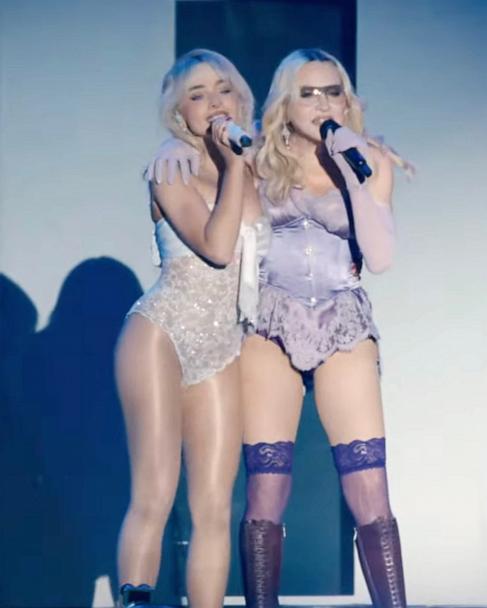
‘Confessions on a Dance Floor’, the part one of this recent part two, was released 21 years ago. In those 21 years so much has changed, and yet also so little. This time, as she burst back on to the industry scene at Coachella with Sabrina Carpenter to perform ‘Bring Your Love’, one of the new album tracks, the top comments related to one thing; how she looked.
In a world where females are told to ‘age gracefully’ but don’t age, that they should appreciate their figures as they age without feeling shamed whilst the media continually dismiss and disregard their recent pledge for ‘body positivity and acceptance’, reverting to skinny is good again, that to stand together and be counted is great, as long as it doesn’t upset what is already in place, I, for one, wasn’t surprised. I was amazed that so many missed the purpose of her reemergence and the message in her music, and could only look not even skin deep but purely skin surface, saying she’d had ‘too much work done’, she was wearing the same corset she wore 20 years previously (far too much for a ‘granny’), and that she was clutching on to a lost career in desperation. In fact, for me, the lyrics, the performances, the interviews (and the smirking) all signpost yet another middle finger to the judgement of those critics that have followed her throughout her career, calling out society’s double standards, doing what she has always done by flouting her defiance of those who apparently have the right to make the rules, and that she felt so passionate that she had the balls to venture back out of what some would have called (preferred) reclusive retirement.
This message from Her Madgesty is not new. Even from the start, with ‘Like A Virgin’, ‘Papa Don’t Preach’ and ‘Material World’, never mind the whole more explicit phase, she has shunned what has gone before, demanded to live life as she wanted and let others do the same, and pushed back on the social establishment dictate driven by the historical clergy, society and commercialisation. She stands firm against the impossible paradox that has been presented to women for certainly the last two hundred years, having to live longer under the scrutinising gaze of others without flinching.
And yet, somewhere in those crowds of naysayers, booers and general lambasters, there was a swell, a chorus, a crowd whose eyes lit up when she appeared on that gangplank, drooled in anticipation of the much secreted but delicious connotations of a new album, and championed arguably one of the most impactful and indelible music Queens and icons that the music world has ever known.
Whether you like Madonna as an artist, a statement or an individual or not, you cannot deny that her following are loyal, subconsciously if not consciously feel sparked by her ‘walking the cliff edge’ attitude and defiance, and her fans (we!) generally have the best time courtesy of Madonna’s music (the few rogue releases forgiven!).
And so, we come to ‘Confessions II’, the new album, for which there was a listening party, but sadly one I wasn’t invited to or could have attended. Instead, I had my own listening party in my front room. And what a party it was. This album is a full night out clubbing captured in one hour and three minutes, played from start to finish, I suspect the exact intention. From tracks to lean on the bar to, ones to drive you to the dance floor and call you out if you’re not there, to post clubnight come down, reflection and piecing together what has gone before; it has it all and in that order.
As expected, some brilliant reminders, maybe to herself but definitely to her audience, of life lessons. “Love is the strangest thing, Just when you think you finally let go, It comes back to you.”
“People really think that there’s a beginning and ending, To this thing called life, but energy never dies, this is just a portal we’re going through. ”
“Everything begins with consciousness.”
These are not lyrics to impress, to throw away, or a regurgitation of a therapist. These are lyrics to remind us to get off the hamster wheel that someone else controls the speed of, to realise the size of particle we, as humans, are in the gargantuan universe we are lucky and should wonder at being part of, and a reminder that to dance is to love, to love is to joy, and to joy is to live a full life. This album is a fantastic club experience for those out for fun and dancing. Her lyrics are not sophisticated, veiled in parts but not difficult to interpret, but to be honest, we don’t fall at our Madonna’s feet and ask her to be a modern Shakespeare or Browning in terms of complexity. We ask Madonna to speak as if she were one of us, we ask her to be vulnerable and wear her heart on her sleeve, and we ask her to help us lose ourselves in the music, which she answers without question.
A couple of the tracks stick out as being a bit too commercial pop for me (sorry Sabrina), but I can see why they would be in there, and she’s never one to shy away from collaboration. And the back end of the album is certainly more reflective; the comedown after the thrill of the night, and poignant in terms of Madonna’s own life happenings. Apart from that, this is an album in the form of Madonna as we have always known her; to the point, honest, and explicitly embracing every day that life gifts her with, and I welcome it for exactly that.
So, to those who have barked about her age, her looks and scoffed at her return, maybe take a leaf out of Madge’s book and you might find you actually enjoy your life that little bit more. We are only here to dance the number of steps external forces deem, so actively embrace each morning and each night, because life is short, we don’t know how long we have, and surely having fun is the most important thing in the end.
Live and let live; it’s good for the soul to let down your hair.
September 2026