
There are albums where you find yourself taken on a journey to another place, and Mama Terra’s ‘Inner Space’ has had me travelling through galaxies, diving into the depths of the ocean and wandering through the chambers of my own mind every time I listen to it.
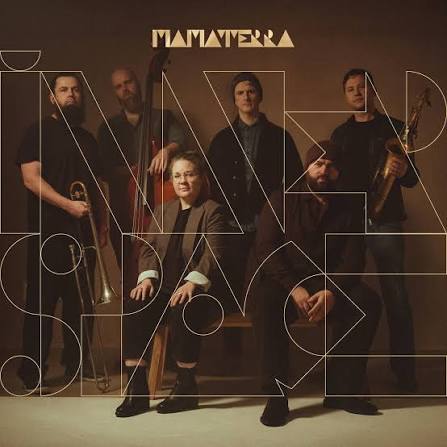
It’s a remarkable collection of nine compositions, bringing together exceptional musicianship, extraordinary arrangements and an almost cinematic sense of storytelling.
The Glasgow-based jazz collective, led by pianist, composer and producer Marco Cafolla, has followed their debut album ‘The Summoned’ with something that feels even more expansive, exploring the human condition, the possibilities of what we are, and perhaps more profoundly, what we might become or create. There’s plenty to get into over its 45 minutes.
The opening title track, ‘Inner Space’, begins with an almost hypnotic snake-charmer quality, the instruments calling and responding to one another, punctuated with bold bursts of brass. It feels like the beginning of a journey, drawing us away from the comfortable and familiar towards something much less tangible, but perhaps all the more important to hear. It also captures the spoken-word narration of Conrad Roberts, whose deep, rich voice immediately commands attention. There’s an almost spiritual quality to his delivery, with the words floating above a backdrop of bass, piano and gentle percussion, offering a moment to reflect, to observe our planet from a different perspective and reach deep into our own minds. The jazz instrumentation gradually builds in urgency, with the drums and vocals gathering momentum as the arrangement opens up, but what strikes me on this track, and, to be honest, most of the album, is the way the musicians allow the composition to breathe. There’s no rush to fill every space; yes, it’s frenetic in places and yes, there’s always something happening beneath the surface, but there are snatches and pauses to allow each aspect to deliver. The end of the track almost makes you catch your breath as we dive off the edge into an intergalactic cosmic darkness (you can read my full review of this track here).
‘Best Laid Plans’ brings a different energy, with an almost funky quality to its opening, the piano keys providing a wonderfully assured foundation, allowing the other instruments to weave their way around the melody. Rachel Lightbody‘s vocals take a much more prominent role here, and it’s lovely to hear her lead a song rather than contribute to the melody. The lyrics themselves aren’t for the faint-hearted; considered commentary on the destruction of our world but also ourselves with relentless competition rather than comfort and satisfaction, an interesting opposition to these wonderful musicians proving what can be accomplished with creative human collaboration. The melodies keep the vibe at a jazz lounge level, and there’s something particularly enjoyable about the way the musicians seem to be having a conversation with one another; rather than competing for attention, each instrument contributes its own thoughts, sometimes stepping forward and sometimes allowing another to take the lead. It’s jazz at its most engaging, with layers of sound that offer something new every time you listen.
Then we plunge into ‘Whale Dives Deep’, where the drums become smoother, and the instrumentation takes on an altogether more fluid quality. The combination of piano, bass and strings creates an extraordinary sense of movement. I found myself imagining the depths of the ocean, with shafts of light filtering down through the water as the music moves between the darkness and the surface, as there’s something almost dreamlike about this composition. A beautiful sense of weightlessness, inviting underwater fantasy films of the 1970’s, and that ability to be able to conjure such vivid imagery without relying on conventional lyrics is one of the things I find most fascinating and impressive about this album.
‘Bliss’ brings Conrad Roberts back into the picture, his narration sitting amongst a more hypnotic, repetitive arrangement, with an incredible double bass groove, courtesy of Ross Saunders. Alongside the piano, it provides a steady pulse, as Rachel’s vocals drift through the composition, adding another layer of emotion. The repetition is particularly effective here. Rather than becoming predictable, it draws you further into the music, with subtle changes in the arrangement continually shifting the atmosphere, running piano scales that sound like waterfalls in parts, Rachel’s voice weaving through the melody. There’s a wonderful sense of musical freedom throughout, but it’s carefully considered freedom; every flourish, pause and change of direction feels as though it was absolutely meant to be there.
‘Perpetuity’ introduces another shift in mood, with the drums and bass providing a more pronounced rhythmic foundation, the piano’s twinkling keys moving in and amongst other instruments, and the vocals adding an almost ethereal quality. I particularly enjoy the way the music can change direction without losing its identity, and this is evident throughout the album. One moment we’re immersed in a deep, almost hypnotic groove, and the next a new melody emerges, taking us somewhere unexpected. You might think one track has ended and another has begun, but not necessarily so; and that doesn’t make for a disjointed listen either. The composition moves between these different spaces with remarkable ease, building layers of sound before allowing them to fall away again.
‘Isha’ opens with a more chaotic energy before leaning into a contemplative melody, with acoustic bass and piano creating a wonderfully gentle passage that gets itself hooked into the inner grey matter for days afterwards. Rachel’s vocals add another layer of instrumentation, showcasing her vocal range beautifully, but also with beautiful restraint, allowing the melody to drift rather than push on. This is definite bebop territory, with that cinematic quality returning once again; I can almost imagine it providing the soundtrack to the life of a modern-day Cleopatra. It holds that more frenetic jazz feel to it, with brass underpinning the vocals; such a full sound to bring in during the second half of the album.
And then comes ‘The Observers’, another complete earworm; and if this one doesn’t get you moving in your seat and singing along, you need to have your pulse taken. One thing is for sure, these tracks live will knock your socks off. Having been lucky enough to catch them earlier on in the year, to watch and listen to this incredible melting pot of sound and performance really is something to behold. It might often feel like each musician has been left to do their own thing, more a jam than an orchestrated piece of music, yet every section is so beautifully considered, each instrument contributing something distinctive to the overall sound. It’s the sort of performance you want to experience again as soon as it’s finished.
‘Dear Green Place’ brings us back towards something more familiar, with a sunnier, more uplifting melody, and a lovely warmth to the piano and strings, the percussion adding a gentle sense of movement. After the expansiveness of the previous composition, it feels almost like returning home, and perhaps that’s part of the beauty of ‘Inner Space’; although the music takes us to extraordinary places, there’s always something recognisably human at its centre.
The album closes with ‘Relativity’, where softer vocals, piano and percussion create a more reflective atmosphere. There’s a wonderful sense of resolution in the arrangement, although not necessarily one that provides all the answers. The instruments continue to move around one another, with space for individual expression and the occasional unexpected flourish, Rachel, Marco and Konrad Wiszniewski having the final musical word. It’s a fitting conclusion to an album that has spent so much time encouraging us to look beyond what’s immediately in front of us.
Throughout ‘Inner Space’, the musicianship is quite extraordinary. Marco’s piano and keyboards provide much of the foundation, but there’s a generosity in the arrangements that allows every contributor to make their presence felt. Konrad’s saxophone, Rachel’s vocals, Ross’ double bass, Doug Hough drums and Mikey Owers on the trombone, alongside the guest brass and strings, all bring their own character to the compositions.
What makes the album particularly special for me is the relationship between those individual performances. There are moments of remarkable complexity, but also passages of such simplicity that a single note or change in rhythm can completely alter the mood; the result of which is music that feels incredibly intricate without ever becoming inaccessible, drawing on jazz, classical influences, soul and funk, with plenty of room for the unexpected.
‘Inner Space’ is an absolutely stunning piece of work, full of imagination, emotion and extraordinary musicianship, which I’ve found myself returning to again and again, sometimes following an individual instrument, sometimes simply closing my eyes and letting the music unfold in its own unique way; and every time there’s something else to discover.
‘Inner Space’ is now available on all streaming platforms and available to buy digitally, CD and on vinyl (while stocks last) via Acid Jazz Records on Bandcamp.
14th October 2026